
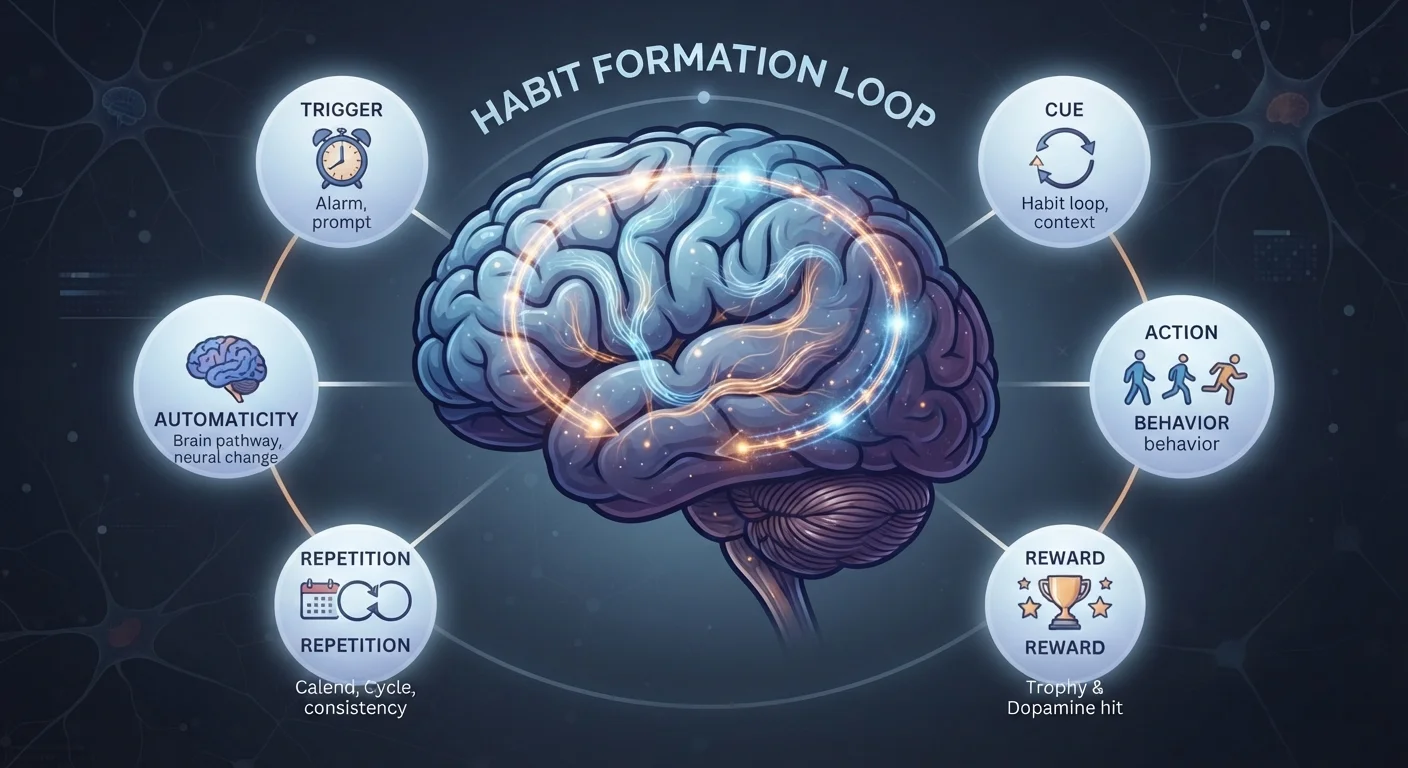
What's Actually Happening in Your Brain
Every time you repeat a behavior in a consistent context, your brain is doing something remarkable: it's encoding that behavior into a more efficient neural pathway. This process - called chunking - allows the brain to offload routine decisions to the basal ganglia, freeing up the prefrontal cortex (your conscious decision-making center) for more demanding tasks.
This efficiency drive is why habits form in the first place. The brain is fundamentally a prediction machine that seeks to minimize effort. Once a behavior is sufficiently practiced, it becomes semi-automatic - triggered by context rather than deliberate choice.
“The process of habit formation is essentially the brain finding a shortcut. What starts as a deliberate sequence of actions gradually becomes a single, automatic chunk - a pattern the brain can run with minimal oversight.”
— Ann Graybiel, Institute Professor and Neuroscientist, MIT McGovern Institute for Brain Research
The implication is significant: you don't just decide to act on a habit. You're responding to environmental signals you may not even consciously notice.
The Habit Loop: Cue, Routine, Reward
Behavioral scientists have identified a three-part structure underlying virtually all habits. Understanding it is the foundation of any practical change effort.
- Cue: A trigger that initiates the behavior - a time of day, an emotional state, a location, or a social situation.
- Routine: The behavior itself, whether physical, mental, or emotional.
- Reward: The positive signal the brain receives that reinforces the loop and makes it worth repeating.
The reward doesn't have to be dramatic. It can be as subtle as a brief sense of calm, a feeling of completion, or a small sensory pleasure. What matters is that the brain registers something worth repeating. This is why starting with small, rewarding behaviors is more effective than tackling sweeping changes.
Design Your Environment Before You Need Willpower
Rather than relying on motivation in the moment, set up your environment in advance to make the desired behavior the path of least resistance. Move healthy snacks to eye level, lay out workout clothes the night before, or keep a water bottle visible on your desk. Small environmental adjustments compound significantly over time.
Why Some Habits Stick and Others Don't
Not all behaviors are equally habit-prone. Several factors influence whether a new routine takes hold:
66 days
Average time for a habit to become automatic
According to research published in the European Journal of Social Psychology by Phillippa Lally and colleagues at University College London.
40-45%
Share of daily actions that are habitual
Researchers at Duke University estimated that nearly half of everyday behaviors are performed habitually rather than through deliberate decision-making.
18-254 days
Range of habit formation timelines
The same UCL study found wide individual variation, underscoring that no single timeline applies to everyone or every behavior.
- Context consistency
- Habits form faster when performed in the same environment and at the same time. Variability in context slows encoding. This is why exercise habits built around a fixed morning window tend to be more durable than those attempted at irregular intervals. Our guide on building sustainable exercise habits explores this in depth.
- Immediate versus delayed reward
- The brain's reward system responds more strongly to immediate feedback. Habits tied to long-term outcomes (like weight loss or financial health) are harder to sustain without engineering some short-term satisfaction. The money mindset principles parallel this - consistent small actions compound over time when reinforced by a sense of progress.
- Friction
- Behaviors with fewer obstacles are adopted more readily. Reducing the friction between you and a desired behavior - or adding friction to an undesired one - is one of the most powerful environmental design tools available.
These factors also explain why small mental wellness habits tend to outlast ambitious overhauls.
Replacing Habits vs. Breaking Them
One of the most durable findings in habit research is that old habit pathways don't disappear - they're suppressed. This is why the most effective strategy for unwanted habits is usually substitution, not elimination. By keeping the original cue and reward but changing the routine, you work with the brain's existing architecture rather than against it.
For example, if stress triggers the urge to snack, identifying a different routine - a short walk, a breathing exercise - that responds to the same cue and provides a comparable reward is more likely to succeed than simply trying to resist. The same principle applies to organizational habits: replacing a clutter-enabling routine with a brief tidy-up ritual uses existing cues more efficiently than willpower alone.
This article is for informational and educational purposes only and does not constitute medical advice. Consult a qualified healthcare professional for guidance specific to your health circumstances.