
What Personal Debt Actually Means
Personal debt is any money borrowed by an individual that must be repaid, typically with interest. It shows up on a balance sheet as a liability - something owed - and it affects your ability to save, invest, and absorb financial shocks. But debt is not inherently destructive. How it's structured, what it funded, and what it costs each month determines whether it's a manageable tool or a source of ongoing financial strain.
Understanding debt starts with recognizing two broad categories: installment debt and revolving debt. Installment debt has a fixed repayment schedule - a set amount borrowed, a defined term, and predictable payments. Revolving debt has a credit limit you can draw on and repay repeatedly, with your required payment shifting based on your balance. Most people carry both kinds simultaneously, which is where complexity begins.
For a grounded look at the habits and attitudes that shape how people relate to debt over time, the Money Mindset hub is a useful companion resource.
The Main Types of Personal Debt
Each debt category comes with its own rules, costs, and consequences:
- Mortgages: Installment loans secured by real estate, typically carrying lower interest rates than unsecured debt. Terms commonly run 15 or 30 years, and interest may be tax-deductible depending on your situation.
- Auto loans: Secured installment loans for vehicle purchases, usually with 3-7 year terms. The asset depreciates, meaning the collateral may be worth less than the balance owed early in the loan.
- Student loans: Available in federal and private forms, with meaningfully different repayment protections and interest rates. Federal loans offer income-driven repayment options and potential forgiveness programs; private loans generally do not.
- Credit cards: Revolving debt with variable balances and, for most cardholders who carry a balance, high interest rates - often well above 20% APR.
- Personal loans: Unsecured installment loans used for a range of purposes, with fixed rates and terms. Because they're unsecured, rates are typically higher than secured loans like mortgages.
- Medical debt: Often unplanned and unstructured, medical debt can arise from a single event and behave differently from traditional consumer debt - some providers offer interest-free payment plans, while unpaid balances may be sent to collections. For context on out-of-pocket healthcare costs, see our healthcare cost overview.
$103,358
Average American household debt
According to the Federal Reserve's Survey of Consumer Finances, the median American household carries substantial debt across multiple categories.
20%+
Typical credit card APR for balances carried
Federal Reserve data shows average credit card interest rates for accounts assessed interest have remained above 20% in recent years.
43%
Share of adults with student loan debt by age 30
Research from the Urban Institute indicates nearly half of young adults carry student loan balances, often alongside other consumer debt.
How Interest Costs Vary - and Why It Matters
The interest rate attached to a debt determines its true cost over time - not just the monthly payment. A $10,000 balance at 5% APR and the same balance at 22% APR look similar in dollar terms at first glance, but the long-run cost difference is substantial. On credit card debt at 22% where only minimum payments are made, the repayment timeline can stretch for years and total interest can exceed the original balance.
Two concepts are worth knowing: APR (annual percentage rate), which reflects the yearly cost of borrowing including fees, and compound interest, where unpaid interest accrues on prior interest. Revolving balances that compound monthly accelerate costs quickly - particularly when minimum payments leave most of the balance untouched.
When comparing debts to pay down first, look at the effective monthly cost - not just the rate. Multiply the balance by the monthly periodic rate to see exactly what each debt is costing you right now.
This concrete dollar figure is often more motivating than an abstract percentage, and it accurately reflects where interest erosion is occurring fastest.
If you carry both a balance-accruing credit card and a card you pay in full each month, keep them mentally separate - conflating them understates your high-cost debt exposure.
People who mentally 'average' their card debt often underestimate the true cost of revolving balances, which delays targeted repayment.
For a deeper look at how beliefs about minimum payments and "good debt" can quietly erode financial health, see our article on common debt myths.
How Multiple Debts Interact
Most people managing debt aren't dealing with a single loan in isolation. A common household picture might include a mortgage, a car payment, student loans, and one or more credit card balances. Each of these draws from the same monthly income, and together they create a debt-to-income ratio (DTI) - the share of gross income consumed by debt payments. Lenders use DTI as a key indicator of financial health; high DTI limits access to new credit and signals that cash flow is under strain.
Beyond the math, multiple debts interact psychologically. Tracking several accounts, due dates, and interest rates creates cognitive load. Missed payments - even on low-balance accounts - can affect credit scores across the board. The relationship between different debts also matters for strategy: paying down high-rate revolving debt frees up cash that can then be directed toward lower-rate installment debts or savings. To understand the structured approaches for that, our guide on debt avalanche vs. debt snowball covers both methods in detail.
Minimum Payments Extend Timelines Significantly
Paying only the minimum required on revolving credit balances keeps you in good standing but dramatically extends the repayment timeline - sometimes by years. A large portion of each minimum payment may go toward interest rather than reducing principal. Always pay more than the minimum when your cash flow allows.
Balancing Debt Repayment With Saving Goals
A common misconception is that all available money should go toward debt until it's eliminated. In practice, this approach often backfires: without any savings buffer, a single unexpected expense sends people back to credit cards to cover it, reversing progress. Financial stability generally requires both tracks to run simultaneously - even at modest levels.
A practical framework: prioritize at minimum a small emergency fund (often cited as $1,000 as a starting point) before aggressively paying down debt. Then, if your employer offers a retirement match, contribute enough to capture it - that match represents an immediate return that typically outpaces even high-interest debt costs. Beyond that, the calculus depends on interest rates, tax considerations, and personal circumstances, and it's worth consulting a qualified financial professional for guidance specific to your situation.
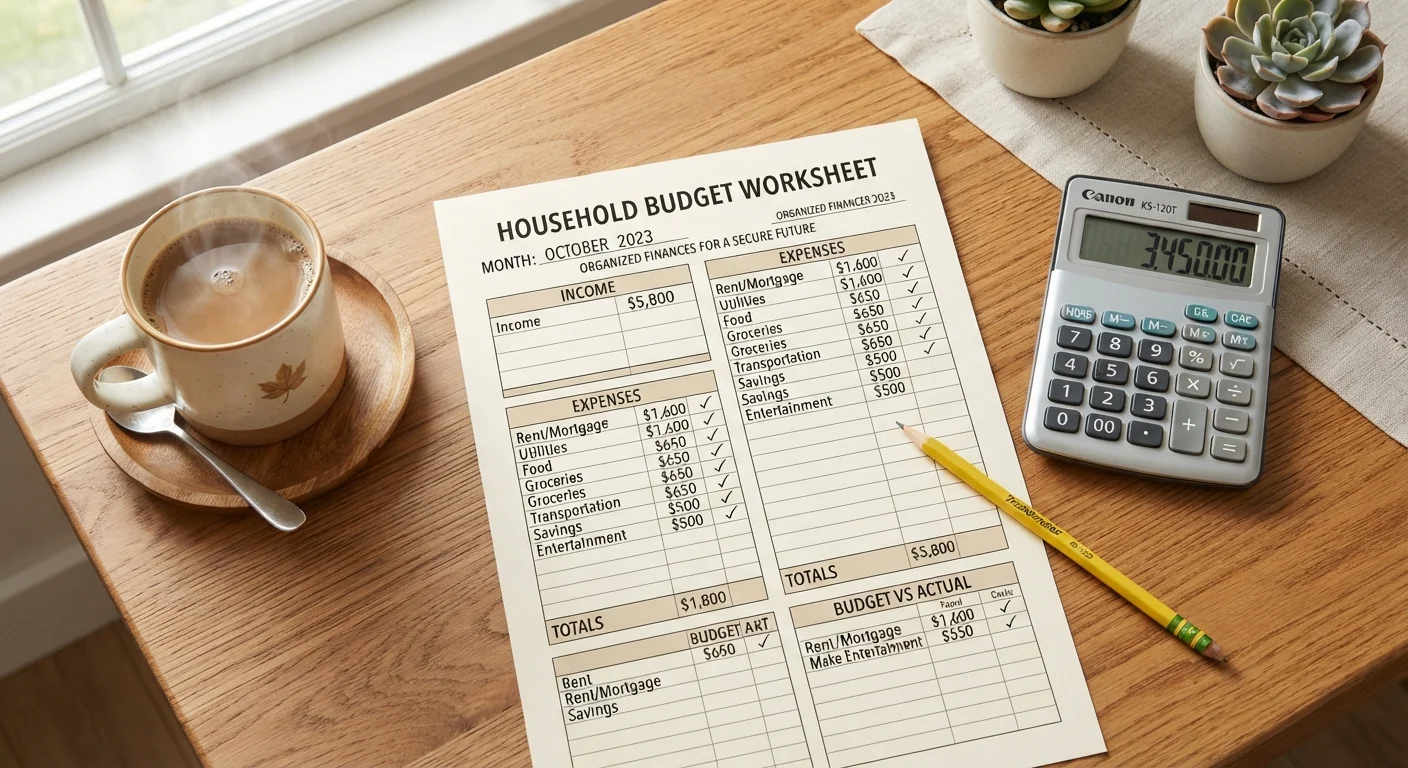
Building a working budget is a foundational step that helps make both goals achievable at once.
Start With an Emergency Fund First
Even a modest emergency fund of $500-$1,000 can prevent high-cost credit card use when unexpected expenses arise. Building this before accelerating debt payoff reduces the risk of taking two steps back for every step forward. Think of it as insurance against your own repayment plan.
Common Patterns That Make Debt Harder to Escape
Debt rarely persists because of a single bad decision. More often, it's sustained by structural patterns: making only minimum payments, not tracking the total balance across accounts, or allowing lifestyle costs to grow in pace with income while balances stay untouched. These patterns are documented - and addressable. Our article on patterns that extend debt repayment outlines the most common ones and how to recognize them in your own finances.
One frequently overlooked factor: the absence of a plan. People who have written a debt repayment strategy - even an informal one - tend to make faster progress than those responding to balances reactively. It doesn't need to be complicated; it needs to be consistent.
A Practical Starting Point
Before choosing any repayment strategy or consolidation option, it helps to map what you owe in full: list every debt, its current balance, its interest rate, its minimum payment, and whether it's secured or unsecured. This single exercise surfaces where the cost is highest and where cash flow pressure is most acute.
From there, proven approaches to high-interest debt can guide your next steps. If simplifying multiple debts is appealing, our overview of debt consolidation explains what it can and cannot solve before you commit to any path.
Debt is manageable when it's understood. The goal of this guide is to give you the full picture - not to eliminate complexity, but to make it navigable.
This article is for general informational and educational purposes only and does not constitute personalized financial, tax, or legal advice. Consult a qualified financial professional regarding your specific circumstances.