
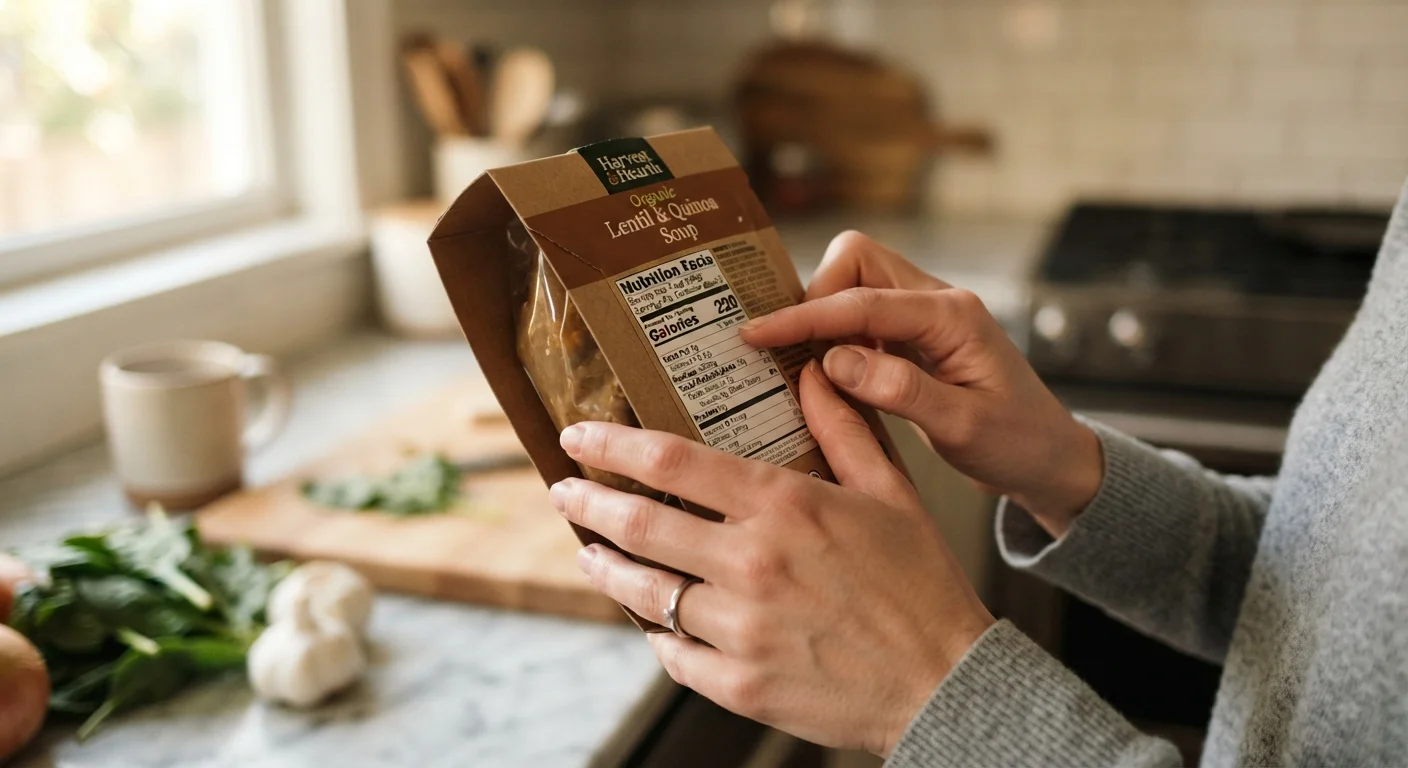
Why Label Literacy Is a Practical Skill
Packaged food labels in the United States are regulated by the FDA and are required to follow a standardized format - which means once you understand the structure, you can apply that knowledge to virtually any product on any shelf. Yet most shoppers glance at a label and walk away less informed than the label was designed to make them.
The challenge isn't the information itself. It's knowing which numbers to prioritize, what percentages actually mean, and how the ingredient list connects to the nutrition panel. If you're building from the ground up, the fundamentals of eating more intentionally offer a useful starting point before diving into label details.
What you will need
The steps below walk through each section of a standard Nutrition Facts panel in the order it appears - from serving size at the top to ingredients at the bottom.
How to Read the Label: Step-by-Step
A packaged food item with a standard Nutrition Facts panel
Provides the real label you'll practice reading during this walkthrough.
Calculator or smartphone
Useful for adjusting nutrient values when you eat more or less than one listed serving.
Find and confirm the serving size
The very first line under "Nutrition Facts" is the serving size. Every calorie count, gram measurement, and percentage on the label is calculated for that specific amount - not the whole package. Serving sizes are standardized by the FDA to reflect amounts people typically eat, but they may not match what you actually consume in one sitting.
Check how many servings per container appear just above the serving size. If a bag lists 3 servings and you eat the whole bag, triple every value on the label.
Read the calorie count in context
Calories appear in large type directly below the serving information. This number reflects the total energy from fats, carbohydrates, and protein in one serving. Calories matter, but they tell an incomplete story. Two foods with identical calorie counts can differ dramatically in nutritional quality.
Use the calorie figure as one data point among several rather than the primary measure of a food's value. For a broader perspective on this, see why nutrient density matters more than calories.
Evaluate nutrients to limit
The label lists saturated fat, trans fat, sodium, and added sugars as nutrients most Americans consume in excess. Saturated fat is measured in grams; the American Heart Association generally suggests keeping it low relative to total daily intake. Trans fat should ideally be zero - even small amounts from partially hydrogenated oils accumulate over a diet. Sodium is one of the most useful numbers to watch on packaged foods, particularly for individuals monitoring blood pressure. Added sugars (distinct from naturally occurring sugars in fruit or dairy) appear as a separate sub-line under total sugars.
Look for nutrients to prioritize
The lower half of the label highlights fiber, vitamins D, calcium, iron, and potassium - nutrients many Americans fall short on. Dietary fiber supports digestive health and sustained energy. Vitamin D and calcium work together for bone health. Potassium plays a role in healthy blood pressure. Seeking foods that contribute meaningfully to these values - rather than just avoiding negatives - is a constructive way to use the label.
Decode the ingredient list
Ingredients are listed in descending order by weight. The first three to five ingredients make up the majority of what you're eating. If refined sugar, corn syrup, or a partially hydrogenated oil appears near the top, that product is predominantly composed of those ingredients. Conversely, a short list of recognizable, whole-food ingredients generally signals less processing. Be aware that sugar appears under many names - dextrose, maltose, evaporated cane juice, and fruit juice concentrate are all forms of added sugar.
"Per Serving" vs. "Per Container" Confusion
A package that looks like a single portion may contain two or more servings. If you eat the whole container without adjusting the math, every number on the label doubles or triples. Always confirm how many servings a package contains before using the listed values.
The 5% / 20% Rule of Thumb
A quick and widely used benchmark: a % Daily Value of 5% or less is considered low for a given nutrient, while 20% or more is considered high. Apply this when you want to limit saturated fat or sodium, or when you're trying to get more of a nutrient like fiber or calcium.
Putting It All Together
Reading a nutrition label well is a matter of habit and sequence. Start with the serving size, let it anchor every number that follows, check the key nutrients on both the "limit" and "prioritize" sides, and scan the ingredient list for quality signals. Over time, this process takes under a minute and becomes second nature.
Labels Are a Guide, Not a Prescription
Nutrition labels are general reference tools based on a 2,000-calorie daily diet, which won't match every person's actual needs. Use them for comparison and awareness, not as personal health targets. If you have a specific health condition, dietary restriction, or nutritional concern, consult a registered dietitian or healthcare provider for personalized guidance.
To put these skills to practical use in your regular shopping routine, the weekly grocery nutrition audit provides a structured checklist for evaluating your overall haul. And if you want to go deeper on evaluating food quality beyond the numbers, explore nutrient density as a decision-making lens.
This article is for general informational and educational purposes only and is not a substitute for professional medical or nutritional advice. Consult a qualified healthcare provider or registered dietitian for guidance tailored to your individual health needs.