
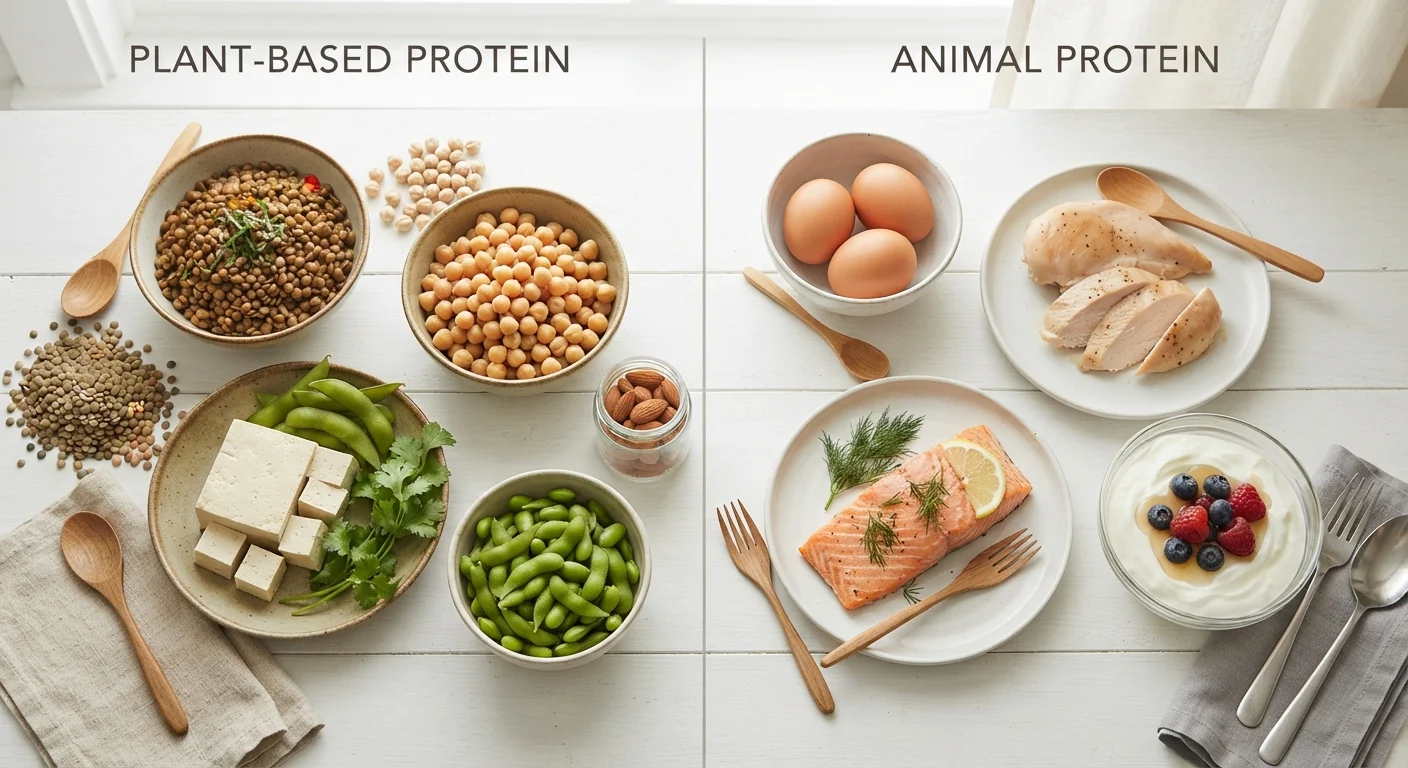
Why the Protein Debate Gets Complicated
Protein conversations in popular health media often default to team-picking - plant vs. animal - as though the answer is simple and singular. In practice, what matters nutritionally is more nuanced: the amino acid profile of what you eat, how efficiently your body absorbs it, and whether your overall dietary pattern fills any gaps.
This article sets aside the ideological framing and focuses on the actual biochemistry and practical dietary implications. As always, this is general nutrition information, not personalized medical or dietary advice. For guidance specific to your health circumstances, a registered dietitian or qualified healthcare provider is the right resource.
Understanding protein quality also fits naturally alongside broader concepts like nutrient density, which reminds us that the value of a food goes well beyond a single number on a label.
Amino Acid Profiles: Complete vs. Incomplete
Proteins are made of amino acids, nine of which are considered essential - meaning the body cannot synthesize them and must obtain them from food. A protein source is called complete when it provides all nine essential amino acids in amounts sufficient to support bodily functions.
Animal proteins - including meat, poultry, fish, eggs, and dairy - are consistently complete. Plant proteins are a more varied story. Soybeans and quinoa are notable exceptions that qualify as complete plant proteins. Most others, such as legumes, grains, nuts, and seeds, are limited in at least one essential amino acid. For example, legumes tend to be low in methionine, while grains tend to be low in lysine.
This is where complementary proteins become relevant. Eating a variety of plant proteins across the day - rice and beans being the classic illustration - allows the amino acid shortfalls of one food to be covered by another. Research supports that this complementarity does not need to happen within a single meal; the body maintains a short-term pool of amino acids that allows for this flexibility.
| Plant Protein | Animal Protein | |
|---|---|---|
| Amino acid completeness | Incomplete in most sources (soy and quinoa excepted) | Complete in virtually all sources |
| Bioavailability (DIAAS) | Moderate; reduced by antinutrients | Generally high |
| Fiber content | Present; supports gut health | Absent |
| Saturated fat | Generally low | Varies; higher in red/processed meats |
| Vitamin B12 | Essentially absent; supplementation needed | Naturally abundant |
| Heme iron availability | Non-heme only; lower absorption | Heme iron; readily absorbed |
| Phytonutrient content | Rich; antioxidants and polyphenols | Minimal |
Bioavailability: How Much Protein Are You Actually Absorbing?
Even if two foods contain the same amount of protein by weight, the body may absorb and use those proteins differently. This concept is called bioavailability, and it's where animal and plant proteins diverge most measurably.
One widely used measure is the DIAAS, which accounts for both amino acid completeness and digestibility. Animal proteins like eggs, dairy, and meat tend to score high on this scale. Many plant proteins score lower, in part because plant cell walls and natural compounds like phytates and tannins can inhibit protein digestion and absorption.
Processing and preparation can close part of this gap. Cooking, soaking, sprouting, and fermenting plant foods can reduce antinutrient content and improve digestibility. Still, it's worth understanding that a gram of protein from a lentil and a gram from a chicken breast are not nutritionally identical in practical terms.
~74%
Digestibility of whole wheat protein
Compared to roughly 97% for egg protein, illustrating the bioavailability gap between common plant and animal sources (per FAO/WHO digestibility data).
~18%
Heme iron absorption rate
Heme iron from animal foods is absorbed at roughly 15-35%, while non-heme iron from plant sources absorbs at approximately 2-20%, according to established nutritional science.
What Each Category Brings Beyond Protein
Proteins rarely travel alone. The nutritional package surrounding them matters enormously for long-term dietary patterns.
Animal proteins are often accompanied by vitamins B12 and D, heme iron (which is more readily absorbed than non-heme iron from plants), zinc, and omega-3 fatty acids (particularly in fatty fish). Some animal sources, especially red and processed meats, also carry higher saturated fat content - a consideration in the context of cardiovascular health according to longstanding dietary guidelines.
Plant proteins bring fiber, which animal sources lack entirely, along with a wide array of phytonutrients, antioxidants, and generally lower saturated fat. However, plant-based diets require attention to nutrients that are less abundant or less bioavailable from plants alone - notably B12 (essentially absent from plant foods), heme iron, zinc, and long-chain omega-3s.
This is why balanced plate principles emphasize variety across food groups rather than reliance on any single source. And when evaluating your choices, considering whole foods versus processed forms of either protein category adds another useful layer of context.
Diversify Within Each Category
Whether your diet leans plant-based, animal-based, or somewhere in between, variety within your chosen protein sources is more nutritionally valuable than relying on a single food. Rotating proteins exposes you to a broader spectrum of amino acids, vitamins, and minerals. If you're uncertain about nutritional gaps in your current pattern, a registered dietitian can help you assess and address them without overhauling your entire diet.
Practical Takeaways for Everyday Eating
For people who eat animal products, the key insight is that diversity within that category matters - leaning on a wide range of sources rather than heavily processed or high-saturated-fat options supports a more balanced nutritional profile.
For those eating primarily or exclusively plant-based, intentional variety is the most effective tool. Rotating between legumes, whole grains, soy foods, nuts, and seeds across the day provides a broad amino acid spread. Paying attention to nutrients of concern - B12 in particular - often requires supplementation or fortified foods, which is worth discussing with a healthcare provider.
For people somewhere in between, the evidence doesn't demand a hard line. Mixed dietary patterns that include both plant and animal protein sources appear in multiple well-studied dietary traditions associated with positive long-term health outcomes. What the research consistently supports is overall dietary pattern quality over isolated food choices.
This article is for general informational and educational purposes only and does not constitute medical or dietary advice. Consult a qualified healthcare professional or registered dietitian for guidance tailored to your individual health needs.