
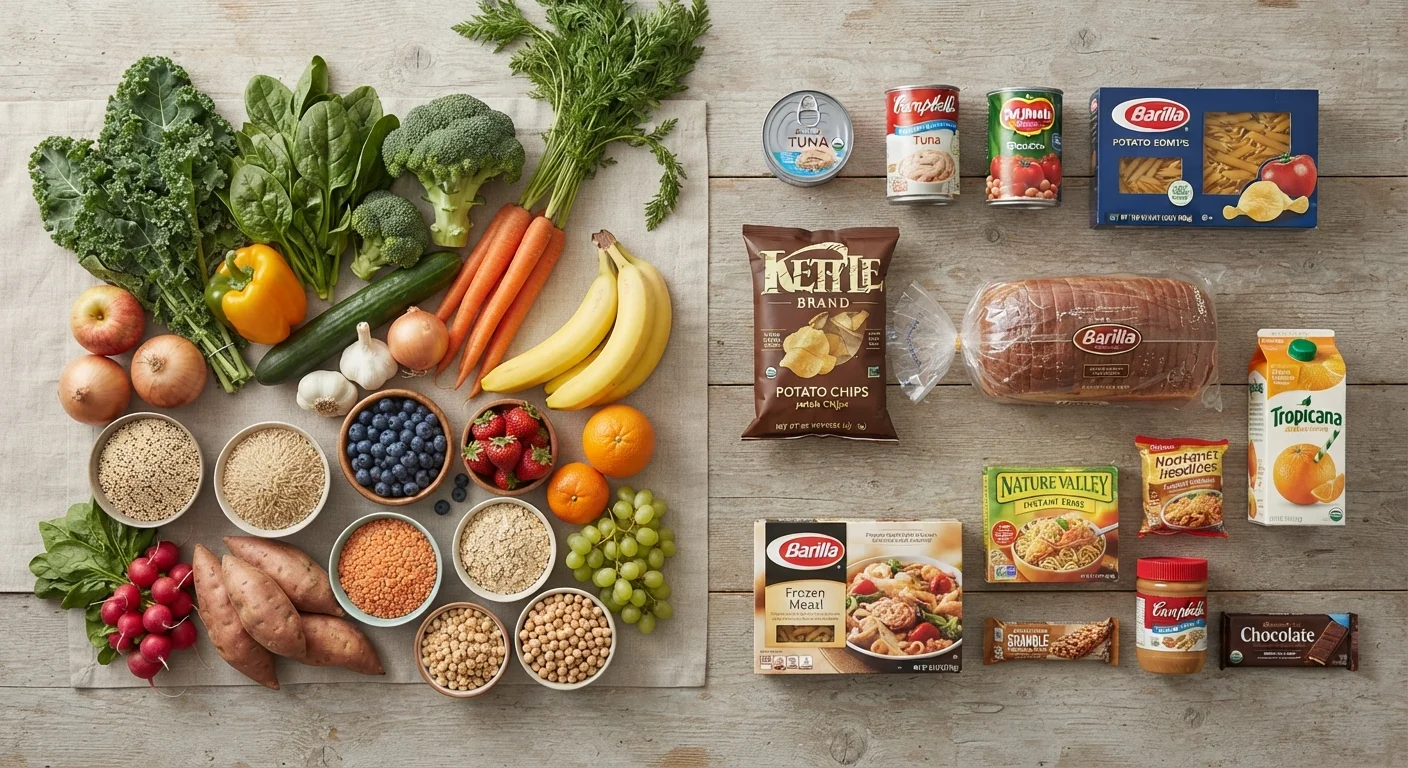
What 'Whole Food' and 'Processed Food' Actually Mean
The terms whole food and processed food get thrown around constantly in nutrition conversations, but they're rarely defined precisely. A whole food is generally understood as a food that is consumed in - or very close to - its natural state. Think a raw apple, a handful of walnuts, a sweet potato, or a fillet of fish. No added ingredients, no industrial transformation. The food's original nutrient structure remains largely intact.
Processed food, by contrast, covers an enormous range. By the most technical definition, almost every food humans eat is processed in some way - cooking, fermenting, pasteurizing, and milling are all forms of processing. The meaningful distinction isn't simply processed versus unprocessed, but rather how extensively a food has been altered and what has been added or removed in that process.
Nutrition researchers often use the NOVA classification system, developed by researchers at the University of São Paulo, which sorts foods into four groups based on the extent and purpose of processing - from unprocessed or minimally processed foods, to culinary ingredients, to processed foods, to ultra-processed food and drink products. This framework is widely referenced in public health research, though it is one of several analytical tools and continues to be refined.
The Processing Spectrum: From Minimal to Ultra-Processed
Picturing processing as a spectrum rather than a binary makes the distinction more useful in everyday life.
| Criterion | Whole Foods | Processed Foods |
|---|---|---|
| Definition | Consumed close to natural state | Altered by manufacturing or preparation |
| Nutrient retention | Generally high | Varies widely by processing level |
| Added ingredients | None | Ranges from none to many additives |
| Fiber content | Naturally intact | Often reduced; sometimes added back |
| Convenience | Requires more preparation | Often ready-to-eat or quick to prepare |
| Shelf life | Shorter for fresh items | Extended by preservation methods |
| Sodium and sugar | Naturally low or absent | Can be significantly elevated |
Minimally processed foods - like frozen peas, canned tomatoes, plain yogurt, or bagged spinach - have been cleaned, trimmed, cut, frozen, or pasteurized. These steps improve safety and convenience without substantially changing nutritional value. In many cases, frozen vegetables are harvested and frozen quickly enough to preserve micronutrients comparably to fresh produce.
Moderately processed foods include items like whole grain bread, cheese, or canned beans. These involve more steps - fermentation, cooking, combining a handful of ingredients - but the result can still be nutritionally valuable, especially when added sugars and sodium are low.
Ultra-processed foods are where nutritional concern is most justified. These are industrially formulated products - think certain packaged snacks, sweetened cereals, some fast food items, and many ready meals - that often contain long ingredient lists of additives, flavor enhancers, emulsifiers, and refined starches or sugars. Research has associated higher ultra-processed food consumption with poorer diet quality overall, though scientists continue to study whether the processing itself or the overall nutritional profile is the primary driver of any observed effects.
To sharpen your ability to distinguish these categories at a glance, learning to read a nutrition label is one of the most practical skills you can develop as a consumer.
What Is Actually Lost - or Gained - Through Processing
Processing affects food's nutritional composition in ways that can go in either direction.
57%
Share of US daily calories from ultra-processed foods
A nationally representative study published in BMJ Open estimated that ultra-processed foods account for roughly 57% of total daily energy intake among US adults.
28%
Fiber retained after grain refining
Refining whole wheat into white flour removes approximately 72% of its fiber content, according to USDA grain processing data.
4 groups
NOVA food processing classification tiers
The NOVA system, developed by University of São Paulo researchers, categorizes all foods into four levels based on the extent and purpose of industrial processing.
What processing can remove: Milling whole grains into white flour strips away the bran and germ, reducing fiber, B vitamins, and minerals significantly. High-heat processing can degrade heat-sensitive vitamins like vitamin C and some B vitamins. The physical breakdown of food structure can also reduce the amount of beneficial fiber that reaches the gut intact.
What processing can add - for better or worse: Fortification adds nutrients back - iodized salt, vitamin D in milk, and folic acid in enriched flour are examples where processing has served a clear public health purpose. On the other hand, many ultra-processed products add refined sugars, saturated fats, and sodium at levels that can make it harder to maintain a balanced overall diet.
Importantly, the food matrix - the physical structure in which nutrients exist - matters as well. Eating an apple delivers fiber, water, and sugars in a form the body processes differently than drinking an equal amount of apple juice, even if the micronutrient profile looks similar on a label. Understanding how fat behaves within food is another dimension of this same principle.
For a broader look at patterns that can quietly shift diet quality without obvious red flags, see our piece on eating habits that undermine good nutrition.
This article is for general informational and educational purposes only and is not a substitute for professional medical or dietary advice. Consult a qualified healthcare provider or registered dietitian for guidance specific to your health needs.