
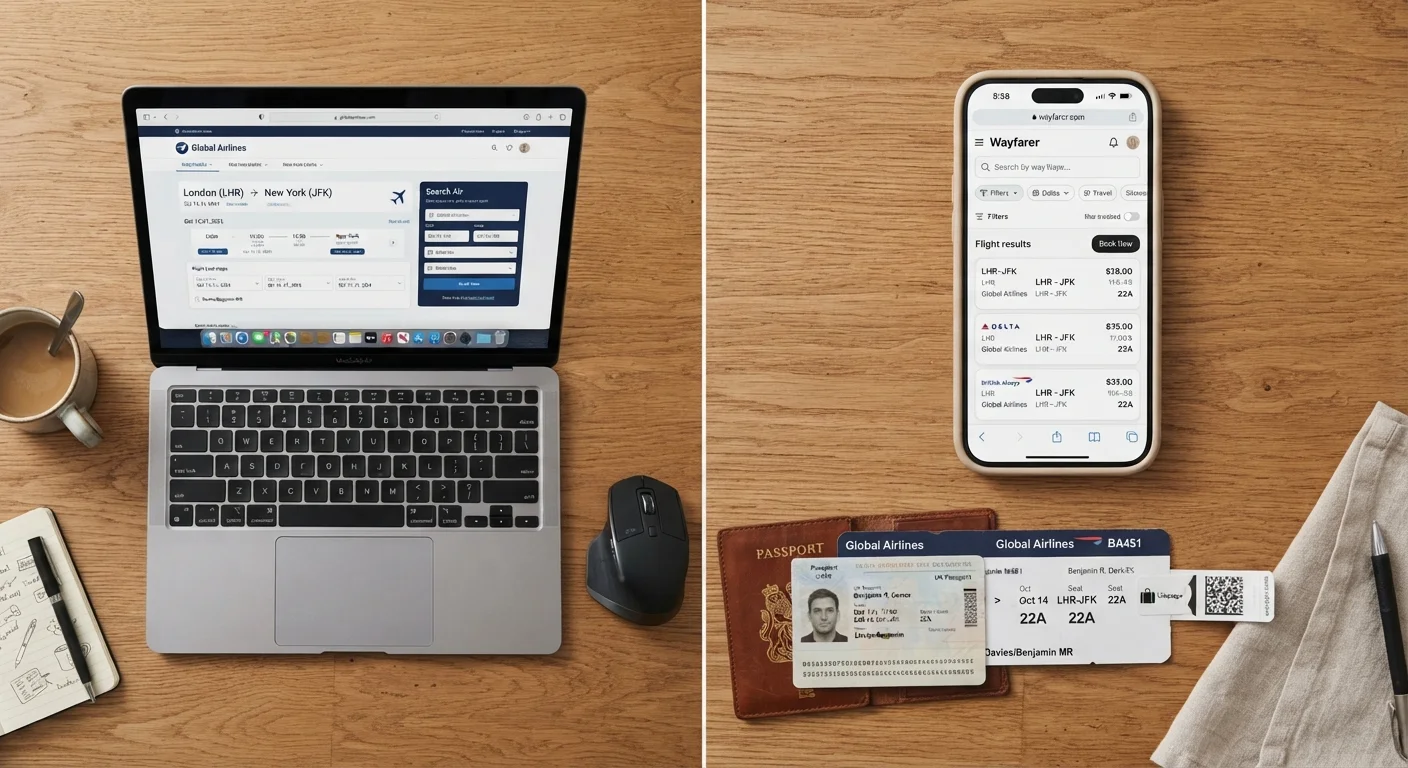
The Core Difference: Who You're Actually Booking With
When you book directly with an airline, hotel, or car rental company, you're entering a contract with that provider. When you book through an online travel agency (OTA) - such as an aggregator or comparison platform - you're transacting with a third party that has its own agreement with the provider. That structural difference shapes almost everything else: your service options, your refund path, and sometimes your price.
Before diving deeper, it helps to understand the basic terminology. An OTA is a platform that sells travel inventory from multiple providers in one place. Booking direct means going to the provider's own website or app. For a plain-language breakdown of terms like these, see our traveler's glossary before you commit to any booking.
| Criterion | Booking Direct | Third-Party Sites |
|---|---|---|
| Price | Often matches OTA; member rates available | Comparable base fare; service fees may apply |
| Loyalty points | Full credit in most programs | Reduced or no credit in most programs |
| Customer service | Direct contact with provider | Through OTA support as intermediary |
| Change/cancellation ease | Generally simpler to manage | OTA must often initiate changes |
| Comparison shopping | One provider at a time | Multiple providers in one search |
| Bundling options | Limited to provider's own packages | Flight + hotel + car combos common |
| Transparency of fees | Provider fees clearly listed | OTA fees may appear late in checkout |
Price: Closer Than You'd Expect - But Read the Fine Print
The widespread assumption that OTAs always offer lower prices is worth questioning. Airlines and hotel chains have increasingly adopted rate parity agreements - contractual terms that require consistent pricing across channels. In practice, this means the base fare you see on a third-party site is often identical to what you'd find booking direct.
Where prices genuinely diverge is in the surrounding fees. OTAs sometimes add their own service charges or booking fees on top of the provider's rate. Conversely, some OTAs negotiate discounted bulk rates that briefly undercut the direct price - particularly for hotel rooms. The key habit: always check both channels before confirming, and make sure you're comparing the same fare class with the same included amenities. Our guide on hidden fees in travel bookings walks through exactly what to scrutinize before you hit confirm.
~50%
Hotel bookings made through OTAs in the U.S.
Industry estimates suggest roughly half of all U.S. hotel bookings flow through third-party platforms, reflecting their significant role in travel shopping behavior.
3-5%
Typical OTA service fee added at checkout
Many OTAs add a service or processing fee ranging from around 3 to 5 percent on top of the base rate, though this varies widely by platform and booking type.
Service, Changes, and When Things Go Wrong
This is where booking direct consistently holds an edge. If your flight is cancelled or your hotel has a problem, direct customers can contact the provider immediately. OTA customers, by contrast, often must go through the third-party's support line first - which adds time and steps during already stressful disruptions.
Airlines are generally not obligated to rebook or waive fees for customers who booked through a third party on the same terms they'd offer direct customers. The OTA technically owns the ticket and must initiate changes on your behalf. During peak disruption periods - weather events, schedule overhauls - that extra layer can matter considerably.
Cancellation terms also deserve close attention. An OTA may advertise a flexible cancellation policy that actually reflects its own policy, not the hotel's underlying terms. The hotel's direct cancellation window may be more generous, or more restrictive, than what the OTA displays. Always click through to the full terms before booking.
Loyalty Programs and Perks
Most major airline and hotel loyalty programs credit points and status nights only for direct bookings, or at a reduced rate for OTA bookings. If you're working toward elite status or accumulating miles for a future redemption, this gap adds up quickly across multiple trips.
Some OTAs offer their own loyalty schemes or member discounts that can partially offset this. Whether those rewards are valuable enough to substitute for provider loyalty depends entirely on how frequently you travel and which providers you prefer. If you're a light traveler with no particular loyalty allegiance, OTA rewards may be perfectly adequate. If you're building status with a specific airline or hotel chain, booking direct is generally the more rational choice.
For travelers exploring options beyond traditional hotels altogether, accommodation alternatives like vacation rentals and home exchanges operate under their own booking dynamics worth understanding separately.
When Each Approach Makes More Sense
Neither channel is the universal answer. The smarter approach is matching the booking method to the specific trip. For routine, flexible bookings where you already know your preferred provider, direct is usually cleaner. For exploratory searches - when you're still deciding between destinations, dates, or property types - OTAs are genuinely useful research tools, even if you ultimately book direct.
Timing also plays a role. The decision of whether to book far in advance or wait until closer to departure intersects with channel choice: last-minute OTA deals exist, but so do direct loyalty member rates that aren't publicly listed. Similarly, if you're weighing whether to bundle everything into one package, all-inclusive packages have their own set of tradeoffs worth examining before you decide.
OTA Opaque Rates: A Special Case
Some third-party platforms offer "opaque" bookings where the provider's identity is revealed only after purchase, in exchange for a steeper discount. These can represent genuine savings but carry trade-offs: you cannot earn loyalty points, changes are typically not permitted, and you have limited recourse if the property doesn't meet expectations. Read the terms carefully before accepting any opaque rate.
This article provides general travel information for educational purposes. Prices, policies, and platform terms change frequently - always verify directly with airlines, hotels, and booking platforms before making any travel purchase.