Why Constraints Can Work in Your Favor
There's a counterintuitive truth about small apartments: the less room you have, the harder it is to ignore a mess. In a large home, clutter can drift to a spare bedroom or an unused corner and stay invisible for months. In a studio or one-bedroom, there's nowhere to hide it. That visibility, though uncomfortable at first, is a powerful motivator.
Small spaces also compress the feedback loop between your habits and your environment. When a coat tossed on a chair makes the whole living room feel cramped, you're more likely to hang it up. When a kitchen counter covered in appliances leaves no room to cook, you're quicker to evaluate what's actually earning its spot. The apartment itself becomes a system that pushes back.
This doesn't mean small-space living is effortless - it isn't. But the friction it creates tends to produce more intentional decisions about what you own and how you use your space. For a deeper look at what happens when you start using walls and height rather than floor area, see our guide on vertical storage strategies.
Forces deliberate decisions about what you own
When every item needs a dedicated home, you naturally become more selective about what enters the apartment. This reduces accumulation without requiring strict minimalism.
Clutter is immediately visible and harder to ignore
There are no spare rooms to absorb disorder. Messes surface quickly, which shortens the time between clutter forming and you addressing it.
Cleaning and tidying take significantly less time
Fewer square feet means faster turnaround - a full reset of a small apartment often takes 20-30 minutes compared to hours in a larger home.
Multi-purpose thinking improves overall efficiency
Small spaces push you to find furniture and tools that serve more than one function, which often results in a more streamlined, functional home overall.
Lower cost to furnish and maintain organized systems
Fewer zones to organize means fewer storage solutions needed, which can reduce both upfront costs and the ongoing time spent maintaining multiple systems.
Where Small Spaces Genuinely Fall Short
It would be dishonest to frame small-apartment constraints as purely beneficial. There are real limitations that no organization system can fully overcome, and it's worth naming them clearly.
Hobby equipment, seasonal items, bulk purchases, and guest accommodations all become logistical puzzles in compact spaces. If you play guitar, do yoga, or enjoy cooking with specialized tools, you'll need to make deliberate trade-offs about what stays and what goes into off-site storage - or simply doesn't come home at all. That's not always a welcome constraint.
Shared small apartments introduce another layer of complexity. When two or more people live in tight quarters with different tidiness standards, the organizational pressure becomes social as much as spatial. Organizing a home when everyone has different habits requires systems that account for more than just square footage.
Hobby and equipment storage becomes a constant challenge
Bulky items like sporting gear, musical instruments, or crafting supplies have no natural home in compact apartments, often requiring difficult trade-offs or off-site storage.
Guest accommodations are limited or uncomfortable
Without a dedicated guest room, hosting overnight visitors requires creative arrangements that can disrupt your own routines and systems.
Bulk buying and pantry stocking are difficult
Small kitchens and limited storage make it hard to take advantage of bulk purchasing, which can affect how efficiently you shop and stock up on essentials.
Shared living amplifies organizational stress
In a small space, one person's disorganization affects everyone immediately. Misaligned habits become friction points that are hard to avoid in close quarters.
Limited flexibility when needs or routines change
A new job requiring home office space, a new hobby, or a new household member can strain a small apartment's organization systems in ways a larger home absorbs more easily.
Practical Moves That Actually Work
Once you understand both the advantages and the limitations of a small space, you can organize it more honestly. A few principles tend to hold up well regardless of layout or budget.
Minimalism Isn't Required
Organizing a small apartment well doesn't mean you need to own as little as possible. It means everything you keep needs a place. If minimalist principles don't suit your lifestyle, that's worth acknowledging - our article on what minimalism gets wrong about home organization separates useful lessons from ones that don't apply to everyone.
Start with subtraction, not storage
Before buying a single bin or shelf, go through what you own. Storage containers won't fix a disorganized home - they just contain the chaos more neatly. The sequence that works is: edit first, then find homes for what remains, then - only if needed - add storage.
Use vertical space deliberately
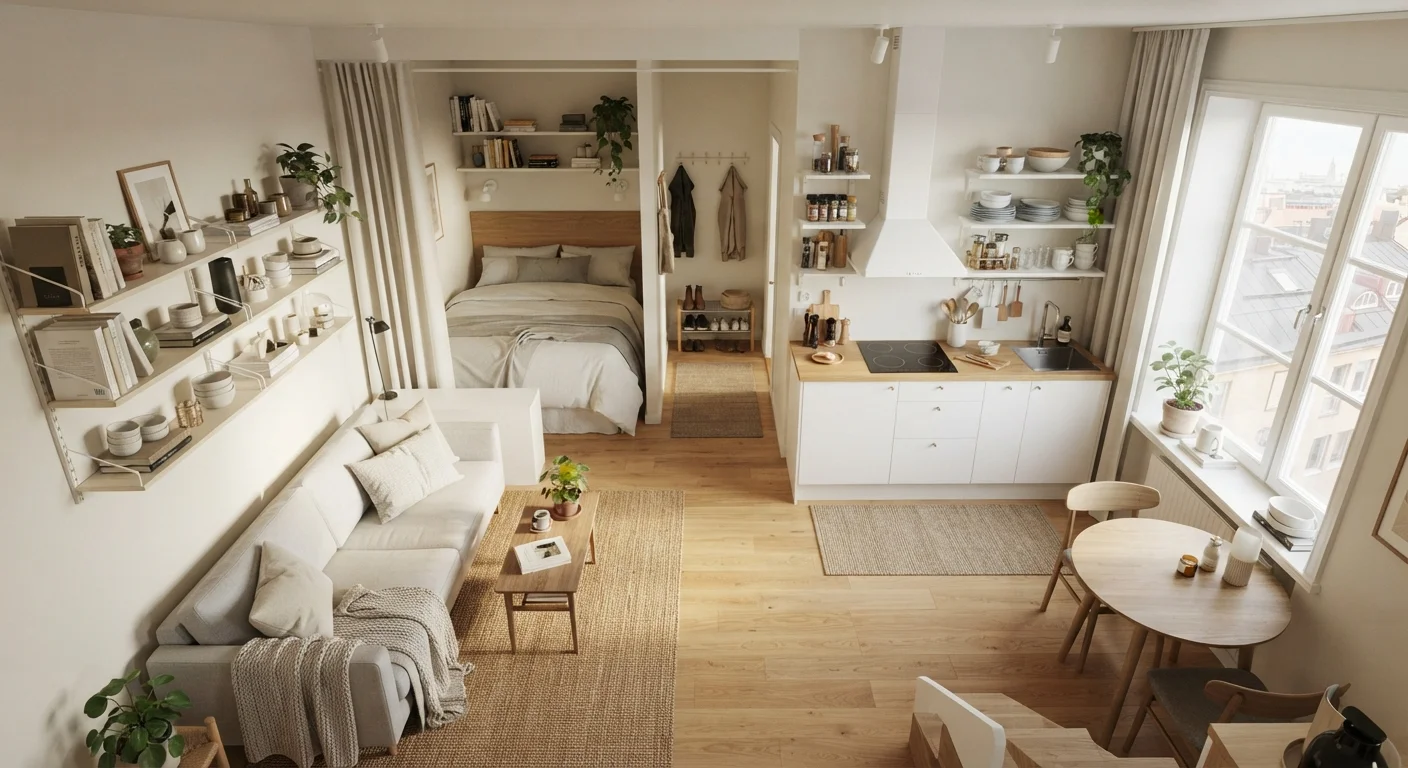
Walls above eye level are the most underused real estate in any apartment. Floating shelves, over-door organizers, and tall bookcases move storage off the floor without eating into living area. Even a few well-placed shelves can meaningfully expand functional storage in a studio.
Build habits, not just systems
A well-organized small apartment depends more on consistent daily habits than on any particular storage product. Putting things back immediately, doing a quick nightly reset, and keeping flat surfaces clear by default are the practices that prevent clutter from quietly rebuilding. Habits that keep a home organized over time are what make any system last.