Why Right-of-Way Rules Exist
Traffic intersections are fundamentally a coordination problem: two or more vehicles want to use the same space at the same time. Without a shared set of rules, every intersection becomes a negotiation - and negotiations at speed are dangerous. Right-of-way rules replace that negotiation with a predictable protocol everyone can learn and apply consistently.
The rules are also written with a specific philosophy: they assign priority to the vehicle or person least protected and most vulnerable. Pedestrians outrank cyclists, who outrank vehicles. Within vehicle interactions, the framework favors the driver who arrived first or is already in motion - because stopping is always safer than a collision.
Understanding the why behind these rules helps drivers apply them correctly in ambiguous situations, rather than guessing or defaulting to assertiveness. Road markings and signage reinforce right-of-way rules visually, but the underlying logic holds even where signs are absent.
Right-of-Way Is a Yield Obligation, Not a Guarantee
Even when you have the legal right-of-way, proceeding recklessly into a conflict is not protected behavior. Courts and insurance adjusters assess whether a driver took reasonable action to avoid a crash - not just who was technically correct. Defensive driving means yielding when it's safe to do so, even if the law doesn't require it.
The Four-Way Stop: Where Most Confusion Lives
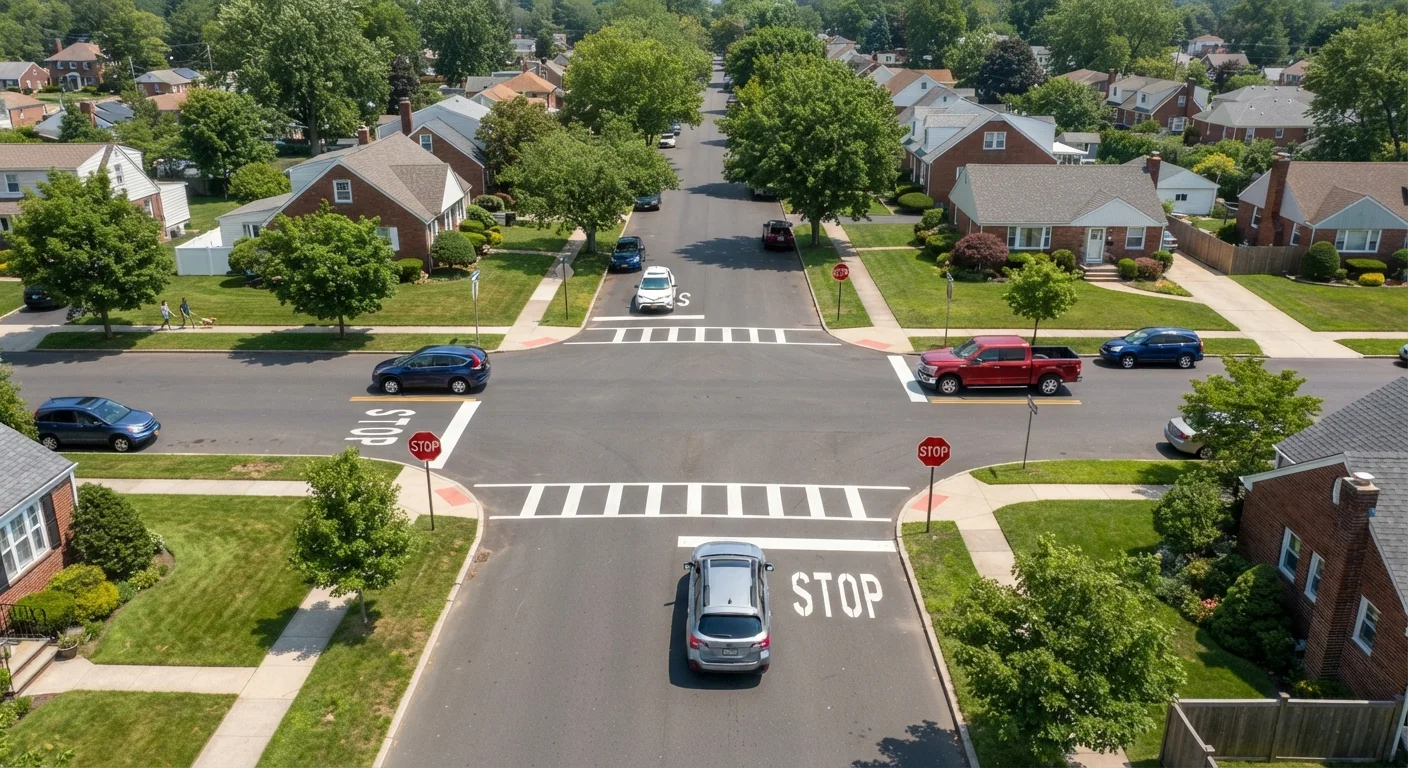
Four-way stops follow a first-in, first-out sequence. The vehicle that stopped first proceeds first - period. Where drivers go wrong is the simultaneous arrival scenario. When two or more vehicles reach the stop line at the same moment, the rule is: yield to the driver on your right. This applies regardless of the direction either vehicle intends to turn.
A second common error involves left turns. A driver turning left across oncoming traffic must always yield to that oncoming traffic - even if the left-turning driver arrived at the intersection earlier. Arrival order does not override directional yield obligations.
~40%
Of U.S. traffic fatalities occur at intersections
According to the Federal Highway Administration, intersection-related crashes account for roughly 40% of all traffic fatalities in the United States.
2x
Higher crash risk at uncontrolled vs. signalized intersections
Research from the Insurance Institute for Highway Safety indicates uncontrolled intersections carry disproportionately higher crash risk relative to their volume compared with signalized ones.
Drivers also frequently wave each other through informally, which creates confusion when two drivers wave simultaneously. If you choose to yield voluntarily, make your intent clear and ensure other drivers have seen it before you stop moving.
Uncontrolled Intersections and Roundabouts
An uncontrolled intersection - no stop sign, no signal - operates under a simple rule: yield to traffic on your right. If a vehicle is approaching from your right, you wait. This applies on residential streets and rural roads where signage is sparse. Drivers who treat these intersections as a free-for-all are misreading the law.
Roundabouts trip up a large share of American drivers because the yield point is counterintuitive. You yield before entering the circle - to traffic already moving inside it. Once you're circulating, you have priority over incoming vehicles. Many drivers do the opposite, hesitating inside the roundabout while expecting entering vehicles to stop, which creates gridlock and rear-end risks.
For a broader look at how environment shapes driving decisions, the city vs. highway driving guide covers how attention patterns and risk awareness need to shift depending on context.
Entering a Roundabout? Look Left First
Circulating traffic in a U.S. roundabout moves counterclockwise, meaning approaching vehicles come from your left. Before entering, check left for any vehicle already in the circle. Yield until there is a clear gap - don't rely on the other driver to slow for you.
Pedestrians, Cyclists, and the Hierarchy That Never Changes
Every U.S. state requires drivers to yield to pedestrians in crosswalks - both marked (painted lines) and unmarked (the implied crosswalk at any intersection where sidewalks would meet). This rule doesn't disappear when a pedestrian is crossing against the light; drivers still carry a general duty to avoid hitting people.
Cyclists on public roads generally have the same rights and duties as vehicle operators, including right-of-way at intersections. In bike-lane scenarios, a right-turning driver must yield to a cyclist traveling straight in the adjacent lane - a collision pattern that is both common and preventable.
Emergency vehicles with active lights and sirens override all standard right-of-way rules. Drivers are required to pull to the right and stop until the emergency vehicle has passed. Blocking or failing to yield to emergency vehicles carries significant penalties in most states.
This article provides general information about traffic rules for educational purposes. Specific laws vary by state - always consult your state's driver's manual or a qualified legal source for jurisdiction-specific guidance.