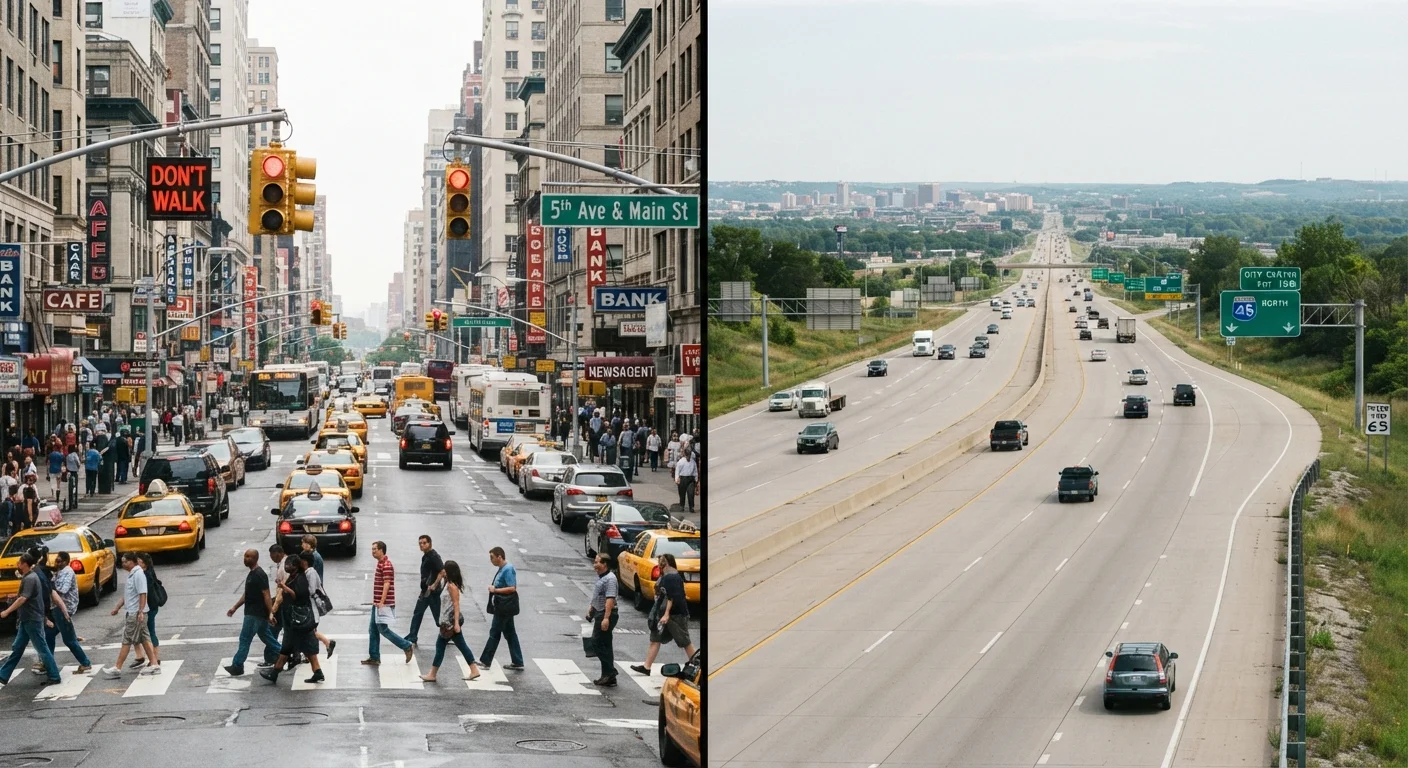
Two Environments, Two Cognitive Modes
City and highway driving are not simply different speeds of the same task - they require fundamentally different cognitive frameworks. In an urban environment, a driver might encounter a pedestrian stepping off a curb, a cyclist filtering between lanes, a double-parked delivery truck, and a changing traffic signal all within a single block. The mental workload is dense and compressed in both time and space.
Highway driving flips those demands. The variables are fewer, the geometry is predictable, and speeds are sustained rather than variable. But the risk of inattention increases sharply precisely because the environment feels monotonous. Research from the National Highway Traffic Safety Administration (NHTSA) consistently identifies driver inattention as a leading factor in highway crashes.
Understanding that you are shifting between two genuinely different cognitive modes - not just pressing harder on the gas - is the starting point. Complacency and subtle distraction are the enemies in both settings, but they show up very differently.
What City Driving Actually Demands
Urban driving is high-frequency hazard management. Speeds may be low - typically 25-35 mph in most American cities - but the number of potential conflict points per mile is far higher than on any interstate. Intersections, crosswalks, bus stops, alley exits, and unpredictable pedestrian behaviour all require continuous short-range scanning.
Key mental adjustments for city environments include:
- Shorter following distances with active scanning ahead: You need enough space to stop for sudden pedestrian crossings or vehicles pulling out, while also reading traffic flow two or three car lengths ahead.
- Intersection discipline: Running a stale green light or misreading a right-of-way situation is among the most common causes of urban crashes. Right-of-way rules exist for clear safety logic - revisiting them matters.
- Managing GPS dependency: Constant turn-by-turn prompts can shift attention away from the live environment. Over-reliance on navigation has real situational-awareness costs.
Pace Yourself in Stop-and-Go Traffic
City driving generates more cognitive fatigue per mile than highway travel due to the sheer frequency of decisions. On long urban drives, allow extra time, avoid multitasking, and take breaks where practical. Recognising mental fatigue early is more effective than trying to push through it.
City driving also tends to produce greater driver stress and fatigue per mile than highway travel, largely due to the decision frequency involved. Recognising this helps you pace yourself on longer urban drives.
What Highway Driving Actually Demands
At 65-75 mph, the physics of driving change in ways many drivers underestimate. Stopping distances increase dramatically: a vehicle traveling at 70 mph needs roughly 300-350 feet to stop under normal conditions - more than the length of a football field. Yet many drivers apply city-style following distances on the highway, leaving almost no margin.
The primary cognitive challenge on interstates is sustained vigilance against monotony. The straight lanes, consistent speed, and reduced decision frequency can lull drivers into a semi-automatic state that slows reaction time. This is distinct from actual fatigue, though fatigue compounds it significantly.
Critical highway-specific habits include:
- The three-second rule (minimum): Maintain at least three seconds of following distance at highway speeds, extending to four or more in adverse conditions. Wet and icy roads change stopping distances substantially.
- Mirror and blind-spot discipline: Lane changes at speed are among the most common highway conflict scenarios. Regular, systematic mirror checks - not reactive glances - are essential.
- Merging awareness: Both entering and being approached by merging traffic require proactive adjustment. Smooth highway merging is a learnable, specific skill.
| City Driving | Highway Driving | |
|---|---|---|
| Typical speed range | 25-40 mph | 55-75 mph |
| Primary cognitive demand | Rapid hazard recognition | Sustained vigilance against monotony |
| Main crash risk factor | Intersection conflicts, pedestrians | Inattention, tailgating, merging errors |
| Recommended following distance | 2+ seconds, situational | 3-4+ seconds minimum |
| Scanning pattern | Short-range, frequent, multi-directional | Wide-field, systematic mirror checks |
| GPS reliance risk | High - diverts attention from live hazards | Moderate - fewer real-time decisions |
Making the Mental Transition Intentional
Most drivers switch between city and highway environments without any deliberate cognitive reset - they simply accelerate onto the ramp or take the exit. But treating the transition as a conscious moment has practical value.
Before entering heavy urban traffic from a highway, give yourself a brief mental prompt: increase scan frequency, reduce following distance, and anticipate intersection conflicts. Conversely, before merging onto an interstate, consciously shift to a wider-field scan, reset your following distance, and remind yourself to check mirrors at regular intervals rather than only when changing lanes.
Many real-world driving adjustments are never formally taught in licensing programs. The ability to self-regulate attention across environments is something most drivers develop informally - which means it's also something that can be developed intentionally.
If you drive both environments regularly, periodic self-assessment is worthwhile. Ask yourself honestly: are you scanning actively, or just watching? Are you following too closely because city habits carried over to the highway? Small recalibrations, made consistently, build the kind of adaptive driving that holds up across conditions. For additional context on preparedness before longer highway trips, see our pre-departure road trip checklist.