Why Slippery Roads Aren't Just a Feel - They're a Physics Problem
Most drivers sense that wet or snowy roads feel different. Fewer understand why - and that gap in understanding is where accidents happen. The underlying issue is friction. Every maneuver your car makes depends on the grip between rubber and road. Reduce that grip and every action - braking, turning, accelerating - requires more distance and more care to execute safely.
Dry asphalt provides a high coefficient of friction, meaning tires can transfer force effectively. Add rain, and a thin water film begins to form between rubber and road. Add snow, and you introduce a compressible, shifting surface. Add ice, and friction can drop so dramatically that normal driving inputs become nearly useless at typical road speeds.
Understanding this isn't academic - it changes how you should time your braking, how much following distance you maintain, and how you handle steering inputs. As covered in what new drivers are rarely formally taught, these situations are seldom part of licensing curricula, which means most drivers develop their knowledge through experience - often expensive experience.
17%
Of all US vehicle crashes occur in adverse weather
According to FHWA (Federal Highway Administration) data, approximately 17% of all vehicle crashes occur during adverse weather conditions including rain, snow, sleet, and ice.
2×
Longer stopping distance on wet vs. dry roads
General engineering estimates place wet-road stopping distances at roughly double those on dry asphalt at the same speed, assuming equivalent tires and vehicle condition.
7-10×
Stopping distance increase on glare ice
The coefficient of friction on glare ice can be below 0.1 compared to 0.7-0.8 on dry asphalt, implying stopping distances seven to ten times longer under similar conditions.
Rain: Hydroplaning, Film Build-Up, and the 35 mph Threshold
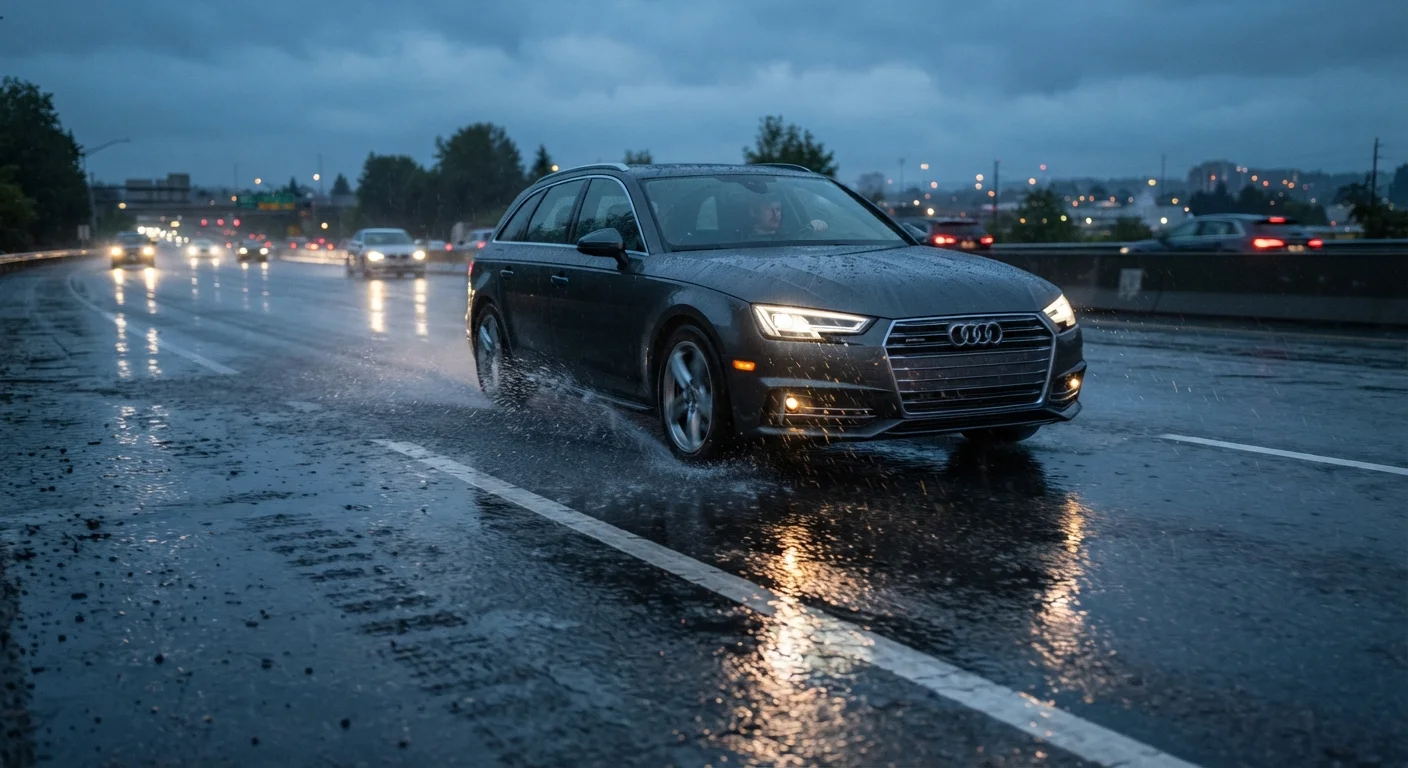
Rain introduces two distinct hazards. The first is a thin water film that reduces friction gradually as roads get wet. The second - hydroplaning - is more abrupt and more dangerous.
Hydroplaning occurs when water accumulates under a tire faster than the tread pattern can channel it away. The tire lifts off the road surface entirely, riding on a wedge of water with almost no steering or braking control. Research from the National Highway Traffic Safety Administration (NHTSA) has associated hydroplaning risk with speeds as low as 35 mph on standing water, with risk rising sharply as speed increases.
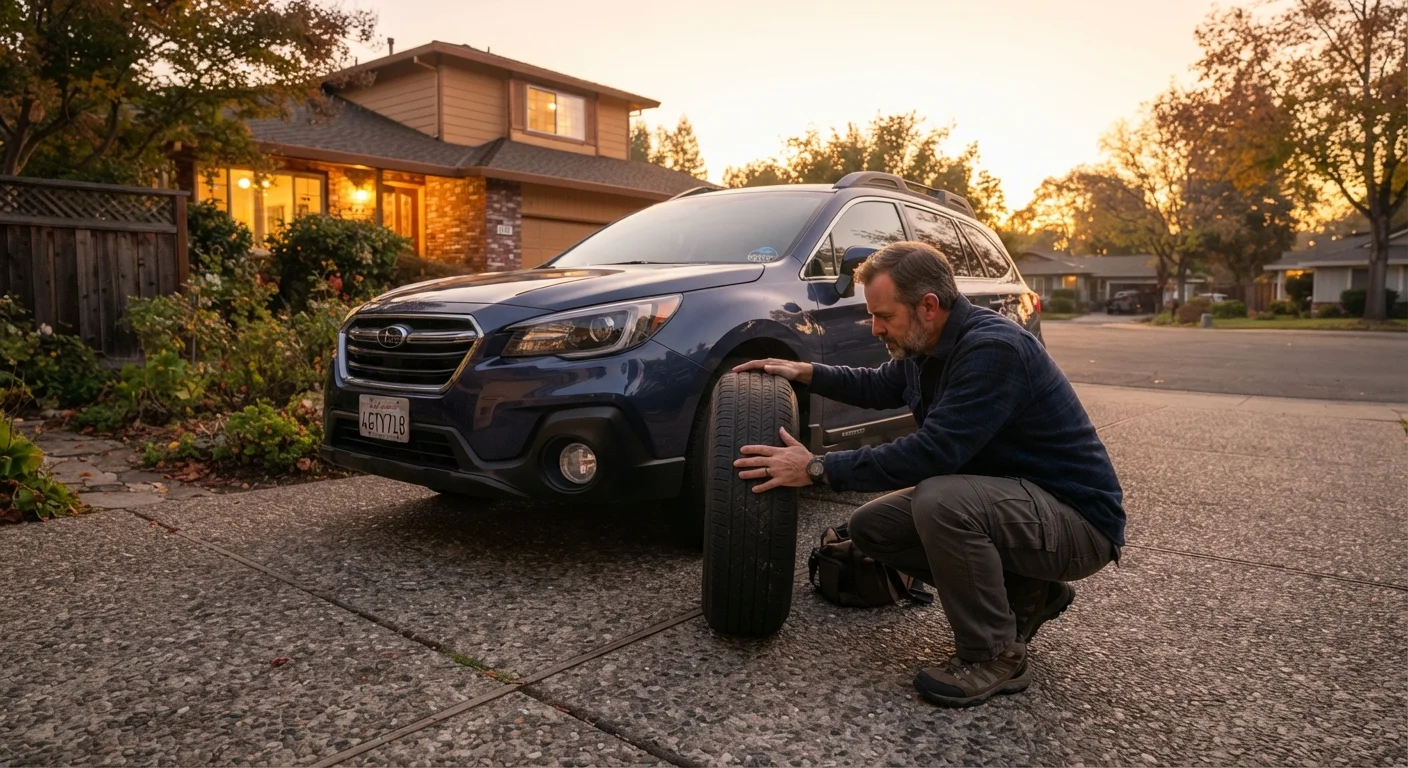
Tread depth is critical here. Worn tires cannot evacuate water effectively - a tire with 2/32" of tread remaining (the legal minimum in most US states) is far more vulnerable to hydroplaning than one with 6/32" or more. Tire tread depth, pressure, and rotation intervals all play a direct role in how your vehicle manages wet conditions.
Check Tread Depth Before Winter Arrives
An easy field test: place a quarter upside down into a tread groove with Washington's head pointing down. If the top of his head is visible, tread depth is around 4/32" or less - consider replacement before winter driving. Waiting until the legal minimum of 2/32" means significantly reduced wet-weather performance.
Snow and Ice: A Spectrum of Grip Loss
Snow and ice are not the same hazard. Fresh, loose snow is compressible - tires sink into it and create some resistance, which provides limited grip. Packed snow offers more surface consistency but still significantly reduced friction compared to dry pavement. Black ice - a thin, transparent glaze that forms when moisture freezes on road surfaces - is the most dangerous condition because it offers almost no visible warning and very little friction.
At temperatures just below freezing (around 28-32°F), ice surfaces can actually be more slippery than at colder temperatures. A thin melt layer forms on the surface that acts almost like a lubricant. This is counterintuitive to many drivers, who assume colder always means worse.
AWD and 4WD systems are frequently misunderstood in these conditions. They distribute power to multiple wheels, which helps with getting moving - but braking physics are identical to two-wheel-drive vehicles. Stopping depends on your tires and brakes, period. Over-reliance on vehicle technology is a documented factor in winter collisions involving AWD drivers who follow too closely or brake too late.
Temperature Matters More Than You Think
Winter tires are formulated with rubber compounds designed to remain flexible below 45°F. All-season tires stiffen in cold temperatures, reducing their grip on snow and ice even when tread depth looks adequate. If you live in a region with sustained winter conditions, tire compound matters - not just tread pattern.
Adjusting Your Inputs: The Core Driving Skill for Bad Weather
On slippery surfaces, the margin for error shrinks dramatically. The skill that compensates is simple in concept but requires deliberate practice: make every input smooth and gradual.
Abrupt steering causes weight to shift suddenly, which can overwhelm available grip and cause a skid. Hard braking on low-friction surfaces triggers wheel lockup (or repeated ABS cycling), extending stopping distance. Sudden acceleration - especially from a stop on ice - spins wheels before forward momentum begins.
The technique that addresses all of these is expanding your planning horizon. On a dry highway, you might follow 2-3 seconds behind the vehicle ahead. In rain, 4-6 seconds is more appropriate. On ice or packed snow, 8-10 seconds gives you the stopping distance you actually need. This habit of looking further ahead and acting earlier is the single most transferable skill for adverse conditions.
For more on how speed and environment intersect with attention, see how urban and highway driving demand different mental approaches. The same principle - matching your awareness to the demands of your environment - applies directly to weather-related conditions. Also worth noting: darkness compounds slippery-road hazards. The risks of night driving are significantly amplified when roads are also wet or icy.