Why Tires Matter More Than Most Drivers Realize
Every braking, steering, and acceleration input your vehicle makes is transmitted through four contact patches - each roughly the size of your palm - where the tires touch the road. No other component has that kind of direct influence on safety. Yet tires are routinely ignored until something goes visibly wrong.
Poorly maintained tires extend stopping distances, reduce handling precision, and increase the risk of sudden failure. Conversely, tires in good condition contribute to fuel efficiency and predictable vehicle behavior. For a deeper look at how surface conditions interact with tire physics, see how wet and icy roads change what happens under your tires.
The good news: the fundamentals aren't complicated. A few checks done consistently make a measurable difference in safety and cost.
Reading a Tire Sidewall
The string of letters and numbers molded into a tire's sidewall contains more useful information than most drivers ever use. Here's what the key markings mean:
Tire size code
The alphanumeric sequence on the sidewall (e.g., 225/55R17) indicating section width in millimeters, aspect ratio as a percentage, construction type, and wheel diameter in inches.
PSI
Pounds per square inch - the unit used to measure air pressure inside a tire. Your vehicle's recommended PSI is on the door jamb placard.
Load index
A number on the tire sidewall that corresponds to the maximum weight one tire can safely carry. Exceeding this limit risks structural failure.
Speed rating
A letter code (e.g., H, V, W) indicating the maximum sustained speed a tire is engineered to handle safely.
Tread depth
The measurement from the top of the rubber tread blocks to the bottom of the grooves. Adequate depth is essential for water evacuation and grip.
DOT code
A Department of Transportation identification number molded into the sidewall. The last four digits indicate the week and year the tire was manufactured.
The DOT code ends with a four-digit number indicating the week and year of manufacture - for example, 2223 means the 22nd week of 2023. This matters because rubber degrades over time regardless of visible wear. The load index is a number (often 88-110 on passenger tires) that maps to a maximum weight the tire can support. The speed rating is a letter indicating the maximum sustained speed the tire is designed for. Both are safety limits - running a tire beyond its rated load or speed shortens its life and raises failure risk.
Tire Pressure: The Most Overlooked Safety Check
Tire pressure is the single most impactful routine check a driver can perform, yet surveys consistently show a large share of vehicles on US roads have at least one significantly underinflated tire.
Check Pressure Monthly - Set a Reminder
Pressure loss of 1-2 PSI per month is normal even in a healthy tire. Setting a monthly phone reminder takes 5 minutes and catches slow leaks before they become emergencies. A basic dial or digital gauge costs a few dollars and is far more reliable than a visual inspection alone.
The correct pressure for your vehicle is on the placard inside the driver's door jamb - not the maximum pressure number printed on the tire sidewall (that's the tire's structural limit, not a target). Most passenger vehicles fall in the 30-36 PSI range, but always defer to the door placard for your specific vehicle.
Check pressure when tires are cold - meaning the vehicle has been parked for at least three hours or driven fewer than a mile - because driving heats air and raises pressure artificially. Underinflation increases rolling resistance, which hurts fuel economy. To understand how driving behavior compounds this effect, see driving behaviors that affect fuel economy.
Tread Depth and When to Replace
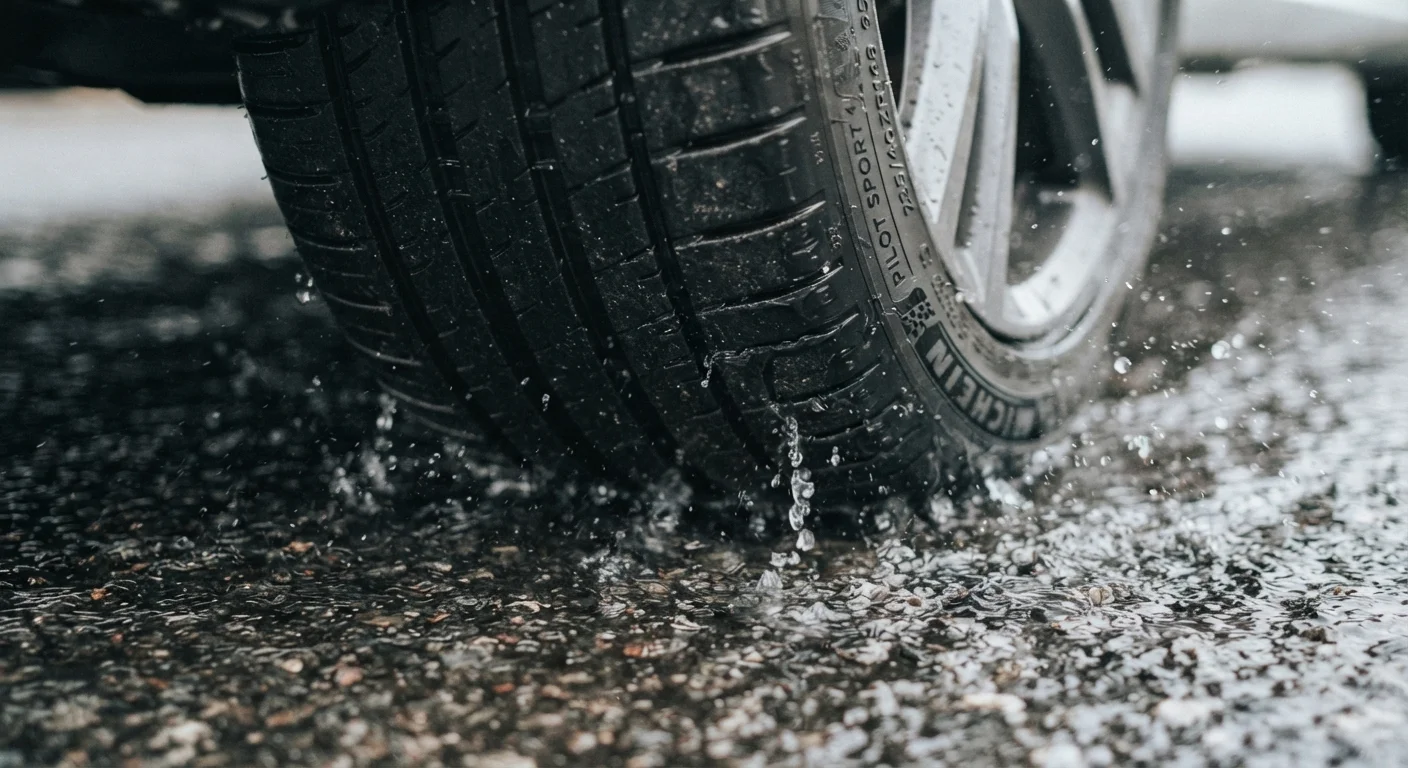
Tread grooves channel water away from the contact patch, maintaining grip on wet roads. As tread wears down, that ability diminishes - braking distances increase, and the risk of hydroplaning rises.
New tires typically start at 10/32 to 11/32 of an inch of tread. US law requires replacement at 2/32 of an inch in most states, but many safety organizations recommend acting at 4/32 of an inch - especially for wet-weather driving. Use the quarter test: if you insert a quarter with Washington's head down and can see the top of his head, you're at or below 4/32 inch.
Don't Wait for the TPMS Light to Act
Your vehicle's Tire Pressure Monitoring System (TPMS) typically triggers a warning when a tire is already 25% below the recommended pressure - well past the point where handling is compromised. Treat the TPMS as a last-resort alert, not a substitute for regular manual checks.
Also inspect tires visually for sidewall bulges, cracks, or embedded objects. A bulge indicates internal structural damage and warrants immediate professional inspection - do not continue driving on a bulged tire. For a comprehensive view of which maintenance tasks to prioritize, see keeping up with car maintenance without getting overwhelmed.
Rotation, Alignment, and Balancing
Three related services work together to extend tire life and maintain vehicle control:
- Rotation moves tires between positions (front, rear, left, right) on a set schedule - typically every 5,000 to 7,500 miles - to even out wear patterns. Many vehicle manufacturers recommend combining rotation with oil changes for convenience.
- Wheel alignment adjusts the angles at which tires contact the road. Misalignment causes rapid, uneven wear and can pull the vehicle to one side. Potholes and curb impacts are common causes; alignment should be checked annually or after any significant impact.
- Balancing compensates for small weight variations in a tire-and-wheel assembly. An unbalanced wheel causes vibration, typically felt in the steering wheel at highway speeds, and causes accelerated wear.
These aren't upsell items - each addresses a distinct problem. Skipping them shortens tire life and can mask developing issues. Tires are a significant part of the broader ownership picture covered in the complete car ownership roadmap, and checking them is a key step in road trip readiness before any long drive.