Why Driving Skills Erode Without You Noticing
Driving skill isn't static. Unlike a manual task you consciously practice, most of us consider ourselves competent drivers and stop actively evaluating our own habits - sometimes decades after we got our license. That gap between perceived ability and actual performance is where risk quietly accumulates.
The pattern tends to look the same: a behavior that was once intentional becomes automatic, and then becomes sloppy. Mirror checks that happened every few seconds start happening whenever something catches your eye. Following distance that was carefully managed becomes whatever feels comfortable. Over time, the skill set narrows without any single moment of failure to point to.
The NHTSA attributes roughly 94% of serious crashes to human choice or error. That figure isn't dominated by reckless drivers - it includes the kind of slow, unnoticed behavioral drift that happens to experienced drivers who stopped paying attention to their own habits.
94%
Crashes attributed to human error
According to NHTSA data, approximately 94% of serious crashes involve a critical human choice or error as a contributing factor.
27 seconds
Cognitive distraction after phone use
AAA Foundation for Traffic Safety research found that mental distraction can persist for up to 27 seconds after a driver stops using a voice-based device.
50%
Crash risk increase on familiar roads
Studies in driver inattention suggest that a significant share of single-vehicle crashes occur on roads the driver travels regularly, where attention naturally drops.
The Habits That Slip Most Often
The mistakes below aren't about inexperience. They're about the specific ways competent drivers let discipline erode once driving feels effortless. Each one is worth treating as a deliberate recalibration, not a personal failing.
Reducing mirror checks on familiar or low-traffic roads.
Why it happens: When a route feels routine and traffic seems light, drivers unconsciously reduce the frequency of mirror scanning - it starts to feel unnecessary.
Glancing at a phone during red lights or slow traffic.
Why it happens: Stopped or crawling vehicles feel safe, so the instinct to quickly check a notification feels low-stakes. The brain categorizes the car as 'not moving, not dangerous.'
Following too closely and trusting the car ahead to signal intentions.
Why it happens: Over years of driving, many drivers develop a false confidence in predicting what other drivers will do based on momentum and flow.
Stopping active visual scanning and defaulting to fixed-point looking.
Why it happens: New drivers are explicitly taught to scan; experienced drivers often stop doing so deliberately and revert to simply looking at the road immediately ahead.
Failing to adjust driving behavior when switching between city and highway environments.
Why it happens: Drivers in a routine commute often carry the same mental mode from one environment into another - highway-style inattention into dense urban grids, or city-style slow scanning at highway speeds.
Over-relying on driver assistance systems instead of maintaining active control.
Why it happens: As vehicles become more technologically equipped, it's easy to treat automated features as autopilot rather than as supplemental tools that require an engaged driver.
Familiarity Breeds Inattention
Research in driver behavior consistently shows that routes driven repeatedly are the ones where serious errors most often occur. When a road feels known, the brain reduces active monitoring and substitutes pattern-matching - a shortcut that works until something unexpected changes. Never treat a familiar route as a low-risk one.
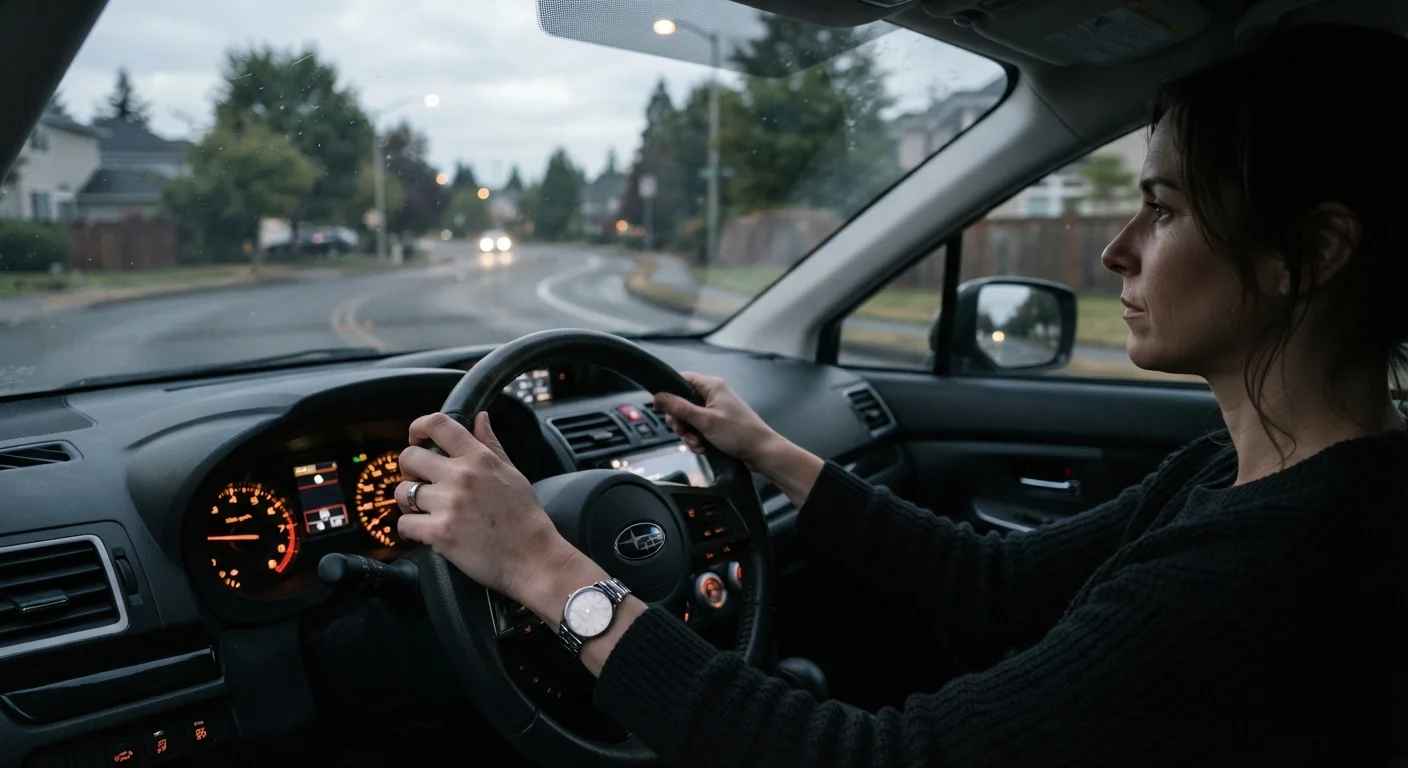
Night conditions amplify nearly every one of these habits. Reduced visibility means that a degraded scanning pattern or an extra second of phone distraction carries significantly higher consequences. Our editorial team has a separate look at night driving hazards and practical preparation for drivers who regularly travel after dark.
Getting Your Habits Back on Track
Recalibrating doesn't require a formal course, though defensive driving courses do offer structured feedback that's hard to replicate alone. What it does require is intentionality - treating your next several drives as conscious practice rather than background tasks.
Driver Assistance Is Not a Substitute for Skill
Features like lane-keep assist and adaptive cruise control are designed to support attentive drivers, not replace them. Relying on these systems as primary safety mechanisms allows core driving skills - scanning, distance judgment, hazard anticipation - to atrophy. Regulators and manufacturers are explicit: these are driver-assistance tools, not autonomous driving systems.
A few practical resets worth building back in: verbally confirm your mirror check sequence for one week; set a following distance goal and count it out consciously; put your phone in the back seat or glove compartment before starting. None of these are complicated, but each addresses a specific habit that experienced drivers most commonly let slip.
If fuel efficiency is also a concern, the same behavioral awareness applies there - aggressive and inattentive driving patterns have a measurable impact on economy. See how driving behavior affects fuel economy for the evidence behind that connection.
This article is intended as general educational information about driving habits. It does not constitute professional driver training advice. Readers with specific safety concerns should consult a qualified driving instructor or certified defensive driving program.