Why Night Driving Is Statistically More Dangerous
Despite accounting for only about 25% of all vehicle miles traveled in the U.S., nighttime driving is associated with roughly half of all traffic fatalities, according to data from the National Highway Traffic Safety Administration (NHTSA). That disparity isn't a coincidence - it reflects the convergence of several compounding risk factors that simply don't exist at the same intensity during daylight hours.
Traffic volume drops after dark, which might suggest lower risk. In practice, the opposite holds. Fewer cars on the road correlate with higher speeds, less social accountability, and more impaired drivers. Fatal crash rates per mile driven are significantly elevated between the hours of midnight and 4 a.m.
~50%
Of U.S. traffic fatalities occur at night
According to NHTSA, roughly half of all fatal crashes happen during nighttime hours despite significantly lower traffic volume after dark.
3-4×
Higher drunk-driver fatality rate at night
NHTSA data shows alcohol-involved fatal crashes are disproportionately concentrated between midnight and 3 a.m. compared to midday.
~100 ft
Typical low-beam illumination range
Standard low-beam headlights illuminate approximately 100-160 feet ahead - potentially less than stopping distance at highway speeds.
Understanding this risk isn't meant to discourage nighttime travel - it's meant to prompt the kind of deliberate preparation that most drivers skip. The gap between daytime and nighttime crash risk is largely addressable through informed habits and basic vehicle maintenance.
The Core Hazards After Dark
Several distinct hazards cluster at night, and recognizing them individually helps drivers prioritize where to focus attention.
- Impaired drivers: Alcohol-involved crashes are dramatically more common at night. NHTSA data consistently shows that the proportion of fatalities involving a drunk driver is roughly three to four times higher between midnight and 3 a.m. than during midday hours.
- Pedestrians and cyclists: Visibility of unlit pedestrians drops sharply. Many pedestrian fatalities occur outside crosswalks on roads with limited street lighting.
- Wildlife: Deer, elk, and other animals are far more active at dusk and dawn. In rural areas, a collision with a large animal at highway speeds can be fatal.
- Road hazards: Debris, potholes, and unmarked construction zones are harder to detect. Low-profile hazards that a driver would spot at 300 feet in daylight may only become visible at 100-150 feet in typical headlight range - not always enough stopping distance at highway speeds.
Don't Dismiss Wildlife Crossing Signs at Night
Deer-vehicle collisions peak in October and November during mating season, but occur year-round on rural and semi-rural roads. At night, slow down and scan the road shoulders when you see wildlife crossing signs - a deer's eyes will reflect your headlights before its body becomes visible. If one animal crosses, assume others are nearby.
For a broader look at how environment shapes driver risk, see city versus highway driving considerations.
How Your Vision Changes in Low Light
Human vision is fundamentally optimized for daylight. In low-light conditions, the eye shifts from cone-based (color, detail) to rod-based (motion, contrast) processing. The practical effects for drivers are significant:
- Reduced visual acuity: Detail resolution drops. A driver who can read a sign at 400 feet in daylight may struggle at 200 feet at night.
- Narrowed depth perception: Judging distances accurately becomes harder, particularly on unlit highways.
- Glare sensitivity: Oncoming headlights - especially modern LED and HID systems - can temporarily reduce effective vision. Averting your gaze slightly to the right edge of your lane is the standard technique to avoid being blinded.
- Age-related decline: A driver in their 50s or 60s may require significantly more light to see as clearly as a younger driver. The pupil's ability to dilate diminishes with age, reducing light intake.
These biological realities underscore why visual habits behind the wheel deserve active attention - especially after dark.
Before a long night drive, spend 15-20 minutes in low light before departing - avoid bright screens or fluorescent environments. This gives your eyes a head start on dark adaptation.
The eye's rods take up to 30 minutes to fully adapt to darkness. Pre-adapting before you drive maximizes your visual capability from the first mile.
When a vehicle with bright headlights approaches, shift your gaze to the right edge of your lane rather than straight ahead, and use it as your guide line until they pass.
Looking directly at oncoming lights causes temporary flash blindness that can persist for several seconds - enough time to miss a road hazard.
Vehicle Preparation for Night Driving
The single most impactful vehicle factor in night safety is headlight condition. Headlights degrade in two ways most drivers don't notice until the problem is severe: the lens housing yellows and hazes over time (reducing light output substantially), and the aim drifts out of alignment from normal road vibration.
A few practical checks worth making before regular nighttime driving:
- Headlight lenses: If the plastic housing looks yellowed or cloudy, light output can be reduced by 50-70% compared to clear lenses. Restoration kits exist and are generally a DIY option; replacement may be warranted for severely degraded units.
- Headlight aim: Misaligned headlights that point too high blind oncoming drivers; aimed too low, they shorten your usable sight distance. Proper aiming can be verified at most service shops.
- Windshield clarity: Interior film builds up on glass over time and scatters light from oncoming vehicles into glare. Clean the inside of the windshield regularly with glass cleaner.
- Wiper blades: Streaking blades create dangerous glare patterns in wet nighttime conditions. Replace blades when they leave streaks.
Before any long after-dark drive, the pre-trip checklist in our road trip readiness guide covers these and additional vehicle checks worth completing.
Degraded Headlights Are a Hidden Safety Issue
Yellowed or misaimed headlights are one of the most common - and most overlooked - causes of reduced night-driving visibility. Many drivers adapt to gradual degradation without realizing how significantly their sight distance has shrunk. Have headlight output and aim checked during routine service, especially on vehicles more than five years old.
Driver Habits That Reduce Night-Driving Risk
Mechanical preparation only addresses part of the equation. Driver behavior accounts for the majority of night-crash causation.
- Increase following distance: The standard three-second following distance is a daylight baseline. At night, extending to four or five seconds provides more reaction time when hazards appear at the edge of headlight range.
- Reduce speed on unlit roads: Posted speed limits are set for normal conditions. On unlit rural roads, traveling at or below those limits is appropriate - particularly when headlights can't illuminate far enough ahead to stop for an unexpected obstacle.
- Use high beams deliberately: High beams roughly double usable sight distance on unlit roads. Switch back to low beams within 500 feet of an oncoming vehicle or when following another vehicle closely - both are legal requirements in most U.S. states.
- Eliminate interior distractions: Dashboard brightness, phone screens, and dome lights all impair dark adaptation. Dim the instrument cluster at night and keep the cabin dark.
Many of these habits overlap with broader driving behaviors that quietly erode safety - worth reviewing for any driver who logs significant nighttime miles.
Dim Your Dashboard at Night
Most vehicles allow instrument cluster brightness to be reduced via a small dial or menu setting. Lowering it reduces the contrast between your interior and the dark road ahead, helping your eyes adjust more effectively. Even a modest reduction makes a measurable difference on unlit highways.
Special Situations: Rural Roads, Fatigue, and Bad Weather
Three scenarios demand extra attention beyond the general night-driving baseline.
Rural and Unlit Roads
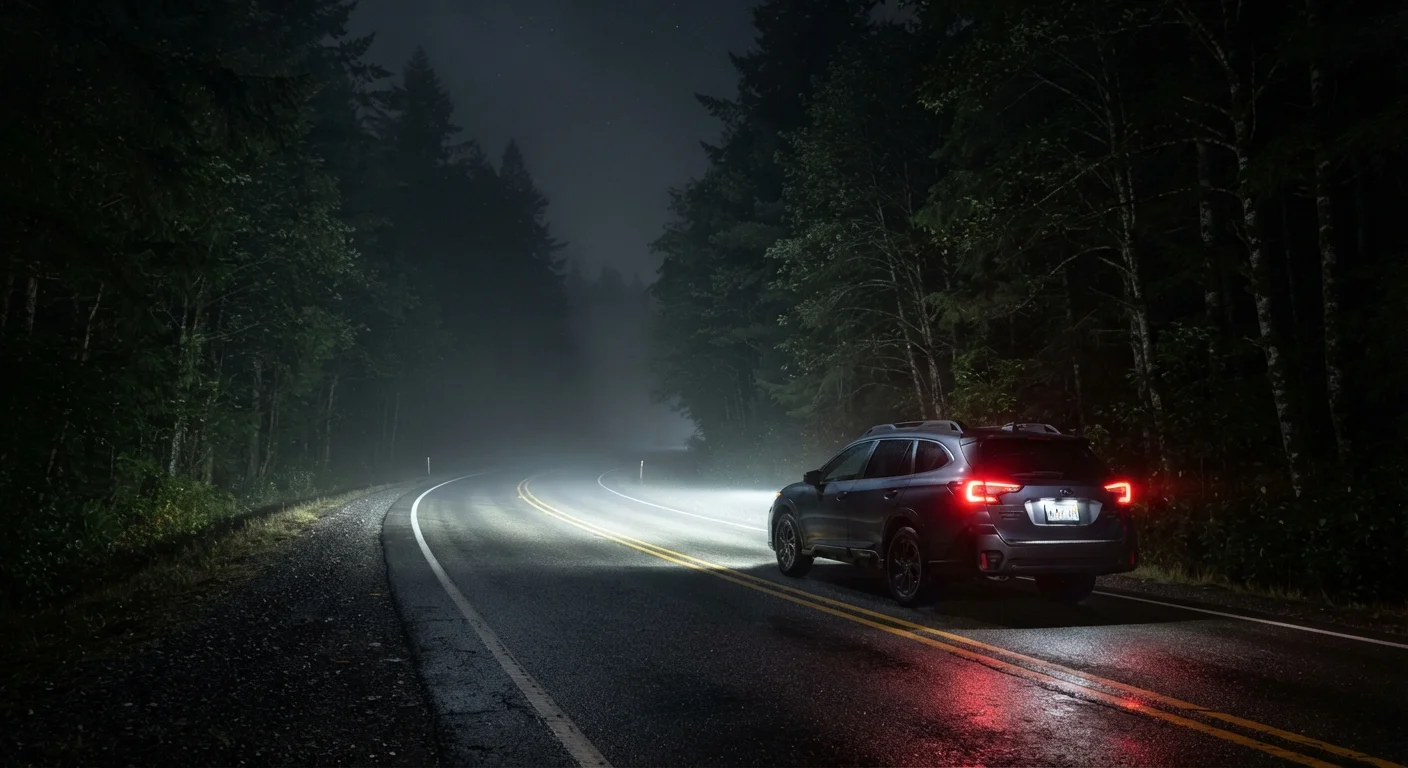
Rural roads account for a disproportionate share of nighttime fatalities. Contributing factors include no center lighting, higher speed limits, wildlife, and fewer guardrails. On these roads, treat high beams as the default and actively scan the road edges - not just the center - for animal movement or debris.
Driver Fatigue
Drowsy driving is most dangerous between midnight and 6 a.m., when the body's circadian rhythm most strongly promotes sleep. Fatigue impairs reaction time comparably to alcohol impairment at certain levels. Warning signs include frequent yawning, lane drifting, and missing exits. If these appear, pulling off safely and resting - even briefly - is the appropriate response. Stimulants like caffeine provide limited and temporary relief; they do not substitute for sleep.
Night Driving in Rain or Fog
Wet pavement reflects headlights and streetlights in ways that make road markings harder to follow. Fog both scatters high-beam light (making low beams more effective in dense fog) and compresses depth perception. In either condition, speed reduction beyond what feels necessary is justified - conditions change faster than they appear to.
For a detailed look at how surface conditions alter stopping distances, see how rain, snow, and ice change vehicle physics. And if you're newer to driving, skills new U.S. drivers are rarely formally taught covers night-driving gaps that most licensing curricula leave unaddressed.