Why Your Eyes Do the Heavy Lifting
Most drivers think of safety in terms of brakes, airbags, or lane-keeping assist. These systems matter - but they all respond to danger that has already arrived. Your eyes, used correctly, detect danger while it's still developing.
The human visual system processes roughly 80-85% of the sensory information used in driving decisions, according to highway safety research. Steering inputs, braking timing, and gap judgments all flow from what you see and when you see it. That means visual technique isn't a soft skill - it's the central mechanism of safe driving.
Most collisions aren't caused by mechanical failure or sudden, unavoidable events. The National Highway Traffic Safety Administration has consistently found that driver error - which includes failures of perception and attention - is a contributing factor in the overwhelming majority of crashes. Poor visual habits are a major subset of that category.
~94%
Crashes linked to human error
NHTSA research attributes the vast majority of motor vehicle crashes primarily to driver-related factors, including failures of perception and attention.
88 ft
Distance traveled per second at 60 mph
At freeway speeds, a vehicle covers roughly 88 feet - about the length of eight average passenger cars - in a single second of inattention.
12-15 sec
Recommended forward visual lead time
Traffic safety curricula in the US consistently teach drivers to look 12-15 seconds ahead to allow adequate hazard detection and response time.
The Mechanics of Effective Scanning
Scanning is not the same as looking. Staring at the car directly in front of you is looking. Scanning means actively sweeping your gaze through a structured pattern: far ahead, middle distance, immediate foreground, left mirror, right mirror - and repeating the cycle.
The 12-15 second rule
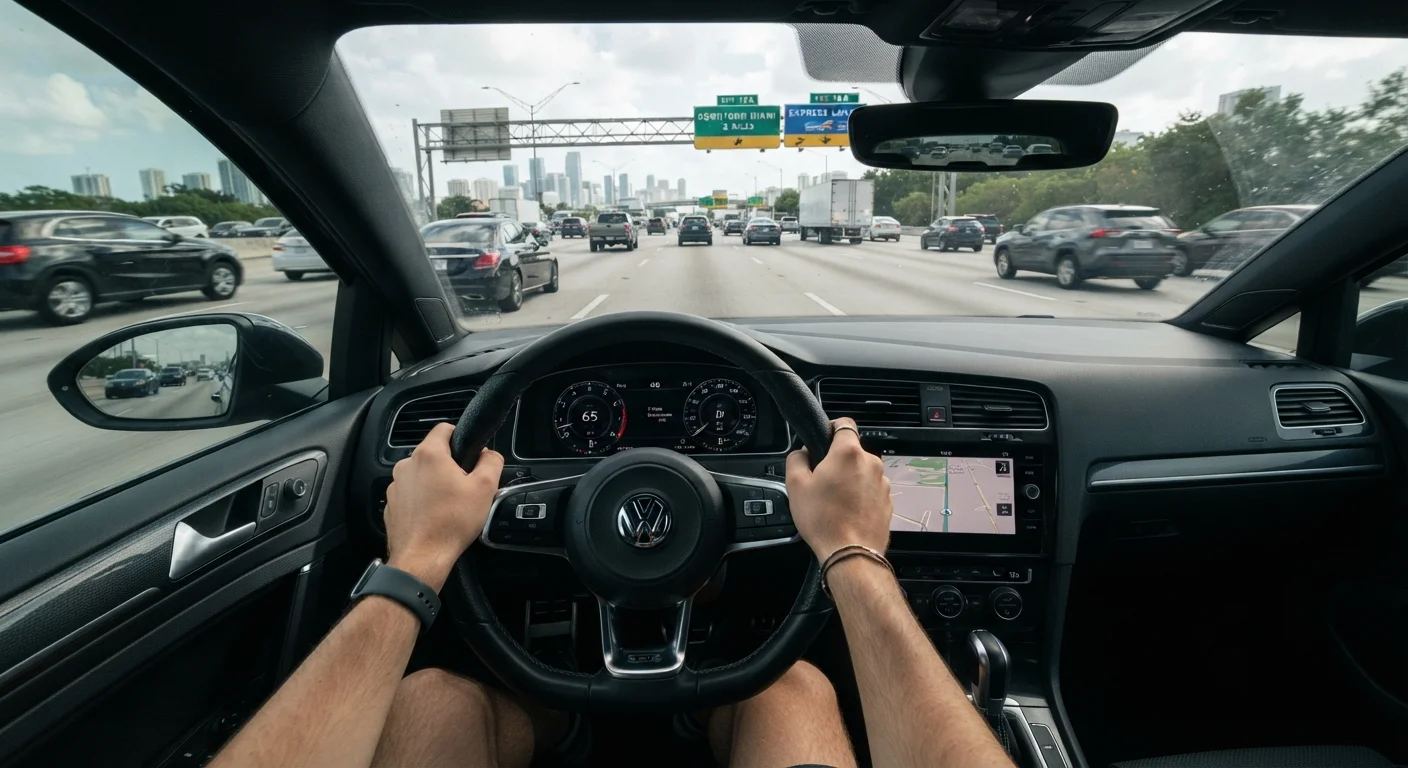
Experienced drivers are trained to keep their forward gaze roughly 12-15 seconds ahead of the vehicle. At city speeds of around 30 mph, that's approximately one city block. On the highway at 65 mph, it extends to roughly a quarter-mile. This distance isn't arbitrary - it matches the time a driver needs to perceive a hazard, decide on a response, and execute a maneuver before reaching the problem.
Checking mirrors on a rhythm
Mirrors provide information about what's behind and beside you, but they're only useful if checked regularly. A scan cycle of every 5-8 seconds keeps your picture of surrounding traffic reasonably current. Longer gaps mean you're relying on outdated information - which matters enormously when merging or braking suddenly. For a closer look at how this plays out in one of driving's more demanding situations, see how mirror and visual timing affect highway merging.
Scanning intersections before entering
Intersections are statistically among the most dangerous points in any trip. Before crossing, a practiced driver scans left, right, and left again - even on a green light. This habit accounts for drivers who run red lights or fail to yield, which mirrors alone cannot detect.
Practice the Scan Cycle Intentionally
On your next routine drive, consciously count mirror checks and track how far ahead your eyes are reaching. Most drivers discover their gaze is shorter and their mirror rhythm slower than they assumed. Deliberate practice during low-stress drives builds the habit before you need it in a demanding situation.
When Good Visual Habits Break Down
Even experienced drivers develop degraded visual patterns over time. Overconfidence, routine, and distraction are the primary culprits - and the decay is typically gradual enough that the driver doesn't notice it happening.
Target fixation is one of the most studied examples. It occurs when a driver locks onto a hazard - a car stopped ahead, a pothole, a pedestrian - and drifts toward it instead of steering around it. The eyes go to the threat; the hands follow the eyes. Knowing this tendency exists is the first step in counteracting it: focus on the gap or escape route, not the obstacle.
Phone glancing is the modern variant of the same problem. A single 2-second glance at a screen at highway speed means approximately 176 feet of road traveled without any visual input. Habitual phone checking doesn't feel risky because nothing bad has happened yet - but it incrementally raises exposure to undetected hazards. The broader pattern of how small habits erode driving quality is explored in our piece on habits that quietly make you a worse driver.
Fatigue narrows the visual field and causes the eyes to stop scanning and fixate, often before the driver feels impaired. Night driving compounds this: reduced ambient light forces the visual system to work harder, increasing cognitive load and accelerating fatigue. Night driving presents specific visual challenges that deserve their own preparation strategy.
“Driving is almost entirely a visual task. The moment you remove vision from the equation - even briefly - you are operating a vehicle without the information necessary to control it safely.”
— Dr. John Lee, Professor of industrial and systems engineering, researcher in driver attention and transportation safety
Adapting Your Visual Strategy to Different Environments
No single scanning pattern works equally well in every situation. City and highway driving demand genuinely different visual approaches - and failing to shift between them is a common source of errors.
In dense urban traffic, hazards appear from multiple directions at close range: pedestrians stepping off curbs, cyclists in blind spots, double-parked vehicles forcing lane shifts. The scanning zone narrows, mirror checks become more frequent, and intersections demand explicit attention each time.
On the highway, the hazard horizon extends. The forward gaze should reach much farther ahead, lane changes require a fuller mirror sequence plus a shoulder check, and speed management becomes a visual task - reading traffic flow three or four cars ahead, not just the vehicle immediately in front. Adjusting your visual mindset between city and highway environments is a concrete skill, not just a general awareness.
Before a long drive - where sustained visual focus is required for hours - verifying that all mirrors are properly adjusted and that your windshield is clear is foundational. These basics are part of the broader pre-departure checklist every driver should run before hitting the interstate.
The core principle across all environments: your eyes should always be moving, always gathering information, and always leading slightly ahead of where your vehicle currently is. That simple discipline is what separates reactive driving from genuinely defensive driving.
Glasses and Contact Prescriptions Matter
An outdated vision prescription directly degrades the quality of visual information your brain receives, reducing effective reaction distance. The American Optometric Association recommends adults have a comprehensive eye exam at least every two years - more frequently if vision changes are noticed. Many states also require corrective lenses to be worn while driving if specified on your license; driving without them when required is both a legal and a safety issue.