Why Merging Goes Wrong
Most merge-related close calls trace back to a single error: treating the on-ramp as a waiting area rather than an acceleration zone. Drivers who slow down, hesitate, or stop before entering the highway force surrounding traffic to react suddenly - exactly the condition that produces near-misses.
The on-ramp exists to give you space and time to reach highway speed before you occupy a lane. When drivers underuse it - braking, creeping, or failing to commit - they arrive at the merge point either too slow or too unpredictable. Both outcomes put everyone at risk.
There's also a common misunderstanding about right-of-way. In most U.S. states, merging drivers must yield to vehicles already on the highway. Highway drivers often move over as a courtesy, but they are not legally required to do so. Understanding this shifts responsibility back where it belongs: with the driver entering the roadway. For a broader look at how right-of-way rules work - and where drivers most often misread them - see the reasoning behind right-of-way rules.
Speed Consistency Is a Courtesy
A driver who varies speed unpredictably is harder for everyone around them to read. On-ramp behavior sets the tone for your first seconds on the highway. Steady, deliberate acceleration signals to other drivers exactly what you're doing - which is the foundation of a safe merge. For more on how speed behavior affects everyone on the road, see common speeding myths.
What You Need Before You Merge
Safe merging begins before the ramp. The habits below apply every time you approach a highway entrance.
What you will need
Step-by-Step: How to Merge Safely
Follow these steps in sequence each time you enter a highway. With practice they become automatic, taking a matter of seconds rather than minutes.
Signal before you accelerate
Activate your turn signal as soon as you enter the on-ramp - not at the last moment. Early signaling gives highway drivers time to register your intention and, if they choose, create space. It also locks in your own commitment to the merge, which reduces hesitation.
Build speed continuously down the ramp
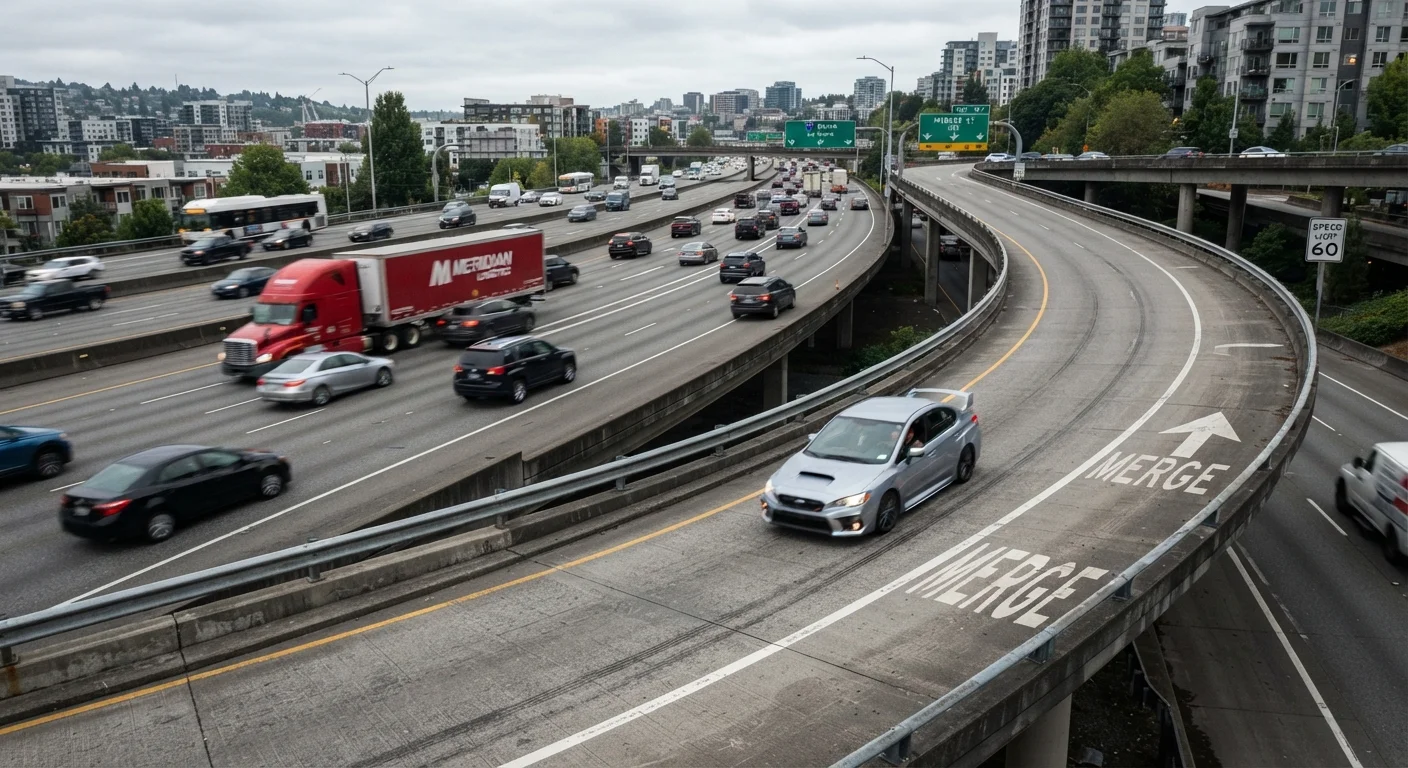
Begin accelerating immediately after entering the ramp. The goal is to arrive at the merge point at or very close to the speed of highway traffic - not to coast and then accelerate at the end. Use the ramp's full length; it was designed for this purpose.
Scan for your gap using mirrors and a shoulder check
While accelerating, check your left mirror to identify traffic in the target lane and gauge the spacing between vehicles. Before committing to the merge, perform a quick shoulder check (glancing over your left shoulder) to cover your blind spot - mirrors alone do not show the full picture. Identify a gap that is at least three to four seconds wide at highway speed.
Match speed to traffic, then move smoothly into the gap
Once you've identified a viable gap, adjust your speed to slot into it - speeding up slightly if the gap is ahead of you, or easing off marginally if it's behind you. When your speed matches and the gap aligns, steer smoothly and decisively into the lane. Avoid drifting or edging; a clear, controlled lane change is safer and easier for surrounding drivers to anticipate.
Cancel your signal and establish your lane position
Once fully in the lane, cancel your turn signal immediately. Center your vehicle within the lane and maintain the speed of surrounding traffic. Avoid braking after the merge unless traffic ahead requires it - unnecessary speed changes disrupt the flow behind you and can contribute to the accordion-effect slowdowns common on busy highways.
Stopping at the End of a Ramp Is a Last Resort
Coming to a full stop at the merge point should only happen if traffic is completely gridlocked and there is genuinely no safe gap. In normal highway conditions, stopping at the ramp's end creates a hazard - drivers behind you on the ramp may not expect a stationary vehicle, and re-accelerating from zero into 60+ mph traffic is far more difficult and dangerous than merging at rolling speed.
When Conditions Complicate the Merge
Standard technique works on a clear ramp with light traffic. Real-world conditions are often less cooperative.
Short or Compressed Ramps
Some urban interchanges offer very little acceleration distance. On these ramps, start accelerating sooner and more aggressively. If the ramp is metered (signaled to release vehicles one at a time), don't let the brief stop cause you to under-accelerate afterward - resume building speed immediately once the light turns green.
Heavy or Stop-and-Go Traffic
When the highway is congested, speed-matching becomes speed-fitting: you're looking for an opening in slow-moving traffic rather than blending into a 65 mph flow. Patience matters here. A short wait on the ramp is safer than forcing a gap that isn't there.
Wet or Slippery Surfaces
Rain, ice, or debris on the ramp reduces the traction available for acceleration. Apply throttle smoothly to avoid wheelspin, and allow extra time and distance to reach merge speed. For a broader look at how environmental conditions affect highway risk, night driving hazards and preparation covers the same principle of adjusting technique to conditions.
Blind or Elevated Merge Points
Some ramps crest a hill or curve sharply before joining the highway, limiting your sightline. Reduce speed slightly on the curve itself to maintain control, then accelerate once the highway is visible. Never accelerate blind into a lane you cannot yet see.
Merging is one of several real-world skills that licensing tests rarely cover in depth. What new drivers are never formally taught explores other gaps that show up once you're behind the wheel without a supervisor.