Why GPS Navigation Has Become the Default
Smartphone-based navigation apps have fundamentally changed how Americans drive. According to data from the Pew Research Center, the vast majority of U.S. adults use their smartphone for turn-by-turn directions at least occasionally, and for many drivers, opening a navigation app is as automatic as buckling a seatbelt.
The appeal is straightforward: real-time traffic data, automatic rerouting around accidents, and lane-level guidance have made arriving on time less stressful and more predictable. For unfamiliar cities or complex highway interchanges, navigation assistance is a legitimate safety tool. The question worth asking is whether that tool belongs on for every drive - including routes you've taken dozens of times.
Understanding the full picture requires looking honestly at both what GPS navigation does well and where routine reliance on it creates real problems. This is especially relevant as urban and highway driving demand different attention patterns, and GPS affects those environments differently.
The Real Advantages of Turn-by-Turn Navigation
There are legitimate, well-documented reasons GPS navigation has become so widely adopted among American drivers.
Reduces stress in unfamiliar or complex environments
Turn-by-turn guidance removes the cognitive burden of route memorization, which is particularly valuable in dense urban areas or when navigating highway interchanges in an unfamiliar city.
Real-time traffic rerouting saves time
Navigation apps continuously monitor traffic conditions and suggest alternate routes around accidents or congestion, often delivering measurable commute time reductions.
Improves accuracy for multi-stop or complex trips
When managing deliveries, road trips with multiple destinations, or appointment-dense days, GPS helps optimize stop order and estimates arrival times accurately.
Alerts to hazards and speed changes
Many apps flag reported road hazards, speed limit changes, and school zones in real time - information that can genuinely reduce the risk of a ticket or an accident.
Accessible for drivers with spatial navigation difficulties
For drivers who struggle with directional orientation, GPS navigation provides genuine independence and reduces the anxiety associated with getting lost.
~77%
U.S. adults who use GPS navigation regularly
Pew Research Center surveys have consistently found that a large majority of American smartphone owners use their device for navigation, making GPS one of the most widely adopted driving tools.
~8 seconds
Average eyes-off-road time per navigation interaction
Transportation safety researchers have estimated that interacting with a navigation interface takes a driver's eyes off the road for several seconds - enough time to travel the length of a football field at highway speed.
Beyond convenience, navigation apps aggregate crowd-sourced incident data - road closures, speed traps, debris - that no individual driver could anticipate. For drivers with anxiety around getting lost, or those navigating a new city for the first time, that real-time awareness has tangible safety value.
The Cognitive and Situational Costs of Always-On Navigation
The downsides of constant GPS use are less obvious but meaningfully supported by research in cognitive neuroscience and transportation safety.
Gradually weakens spatial memory and map-reading skills
Research in cognitive neuroscience indicates that outsourcing navigation to an app reduces the brain's active engagement with spatial reasoning, which can erode the ability to navigate independently over time.
Reduces situational awareness on familiar routes
When drivers focus on the next instruction rather than the road environment, they may miss relevant contextual cues - pedestrian behavior, weather-related hazards, or changing road conditions.
Apps can route drivers into unsafe or inappropriate roads
GPS systems have misdirected drivers onto roads unsuitable for standard passenger vehicles, including unpaved routes, roads with weight restrictions, or areas prone to flooding.
Vulnerable to dead zones and connectivity loss
Rural, mountainous, and tunnel-heavy areas can disrupt the cellular signal navigation apps depend on, leaving drivers without guidance at exactly the moments it would be most useful.
Contributes to driver distraction
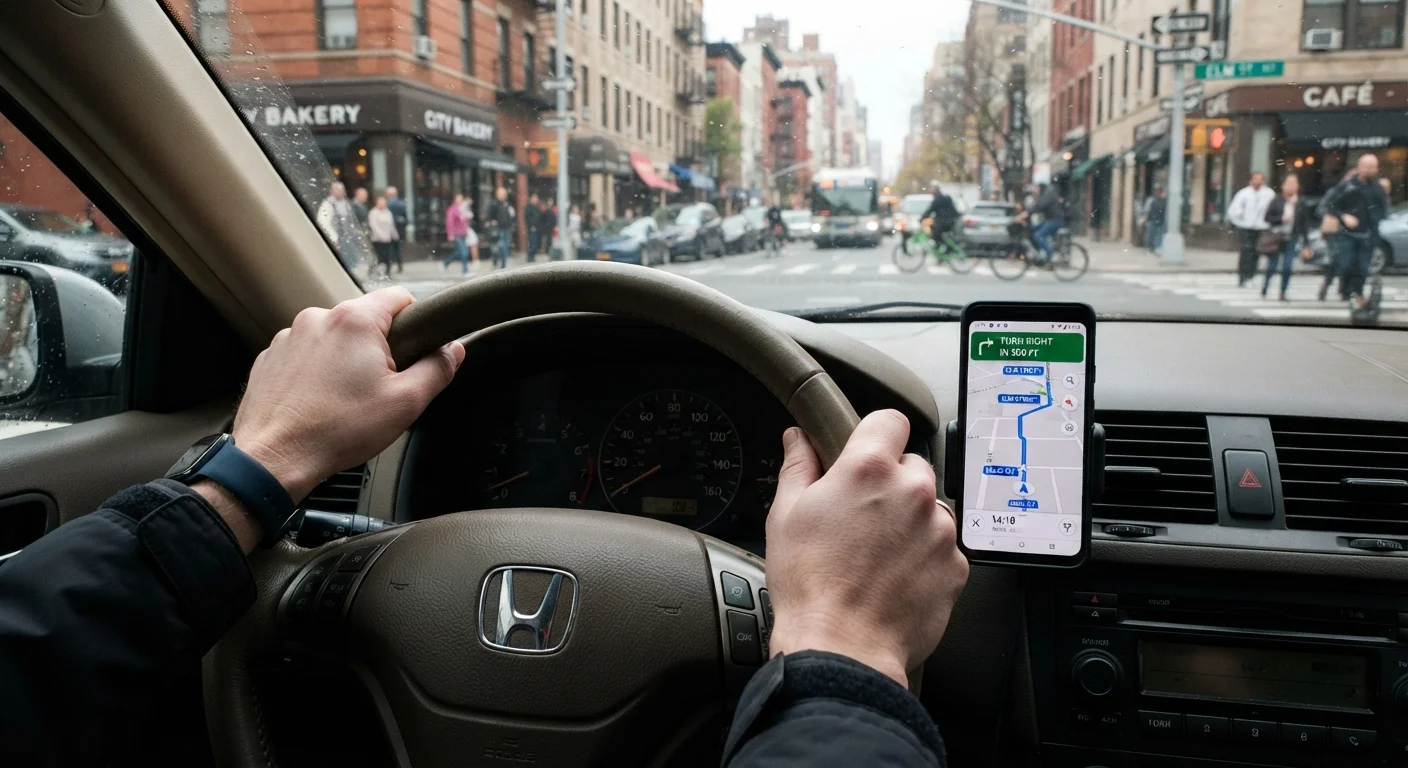
Even a brief glance at a mounted navigation screen is a form of visual and cognitive distraction; the NHTSA identifies distraction as a consistent factor in crash data.
Map data can lag behind real-world changes
New construction, rerouted roads, or recently closed lanes may not be reflected in an app's database, leading drivers to follow outdated instructions into problem areas.
A notable body of research, including studies from University College London, has found that relying heavily on GPS navigation reduces activity in the hippocampus - the brain region involved in spatial memory and map-building. In practical terms, drivers who always use GPS often struggle to describe familiar routes or recover from unexpected detours without reopening the app.
Spatial Memory and Regular GPS Use
Studies from University College London, including research published in Nature Communications, found that people who rely on GPS show less activity in the hippocampus while navigating compared to those using mental maps. The hippocampus plays a key role in spatial learning and memory consolidation. This doesn't mean GPS causes permanent cognitive harm, but it does suggest that skills not practiced tend to weaken - which applies to navigation just as it does to other learned abilities.
There's also a situational awareness problem. When a driver is listening for the next instruction rather than actively reading the road environment, they may miss contextual cues - a merging truck, a flooded underpass, a construction redirect - that a more attentive driver would catch.
When GPS Misdirects: Real Failure Modes
Navigation apps are not infallible, and their errors can range from mildly inconvenient to genuinely dangerous. Common failure modes documented by transportation researchers and widely reported by drivers include:
- Routing onto inappropriate roads: Apps have directed passenger vehicles down logging roads, through flood-prone areas, or onto roads with clearance restrictions unsuited to certain vehicles.
- Outdated map data: Road closures, new construction, or changed traffic patterns may not be reflected in app databases immediately.
- Signal dead zones: Rural and mountainous areas frequently lack the cellular connectivity apps require, leaving drivers without guidance at the worst possible moment.
- Distraction from the device itself: Interacting with a mounted phone - even glancing at it - contributes to cognitive distraction. The NHTSA has consistently identified distraction as a leading factor in vehicle crashes.
None of these failure modes make GPS navigation dangerous in itself, but they do underscore why treating the app as a fully reliable co-pilot rather than a tool with limitations carries real risk.
Finding the Right Balance for Your Driving Habits
The most practical approach is intentional rather than automatic use. Consider reserving GPS navigation for situations where it adds clear value: unfamiliar destinations, multi-stop trips, time-sensitive travel through high-traffic corridors, or driving in conditions where real-time hazard data is genuinely useful.
For familiar commutes and routine errands, driving without navigation keeps spatial reasoning active, builds environmental familiarity, and reduces screen dependency. It also means you're less likely to be caught off guard if your app fails when you actually need it. This kind of deliberate tool use parallels decisions in other areas of daily life - knowing when monitoring helps and when it creates dependency is a recurring theme across technologies we adopt for convenience.
If you do use navigation regularly, some practical habits help preserve your awareness: study the route overview before departing so you understand the general path, keep the screen in your peripheral view rather than fixating on it, and stay mentally engaged with the road rather than treating the app as a full autopilot.