
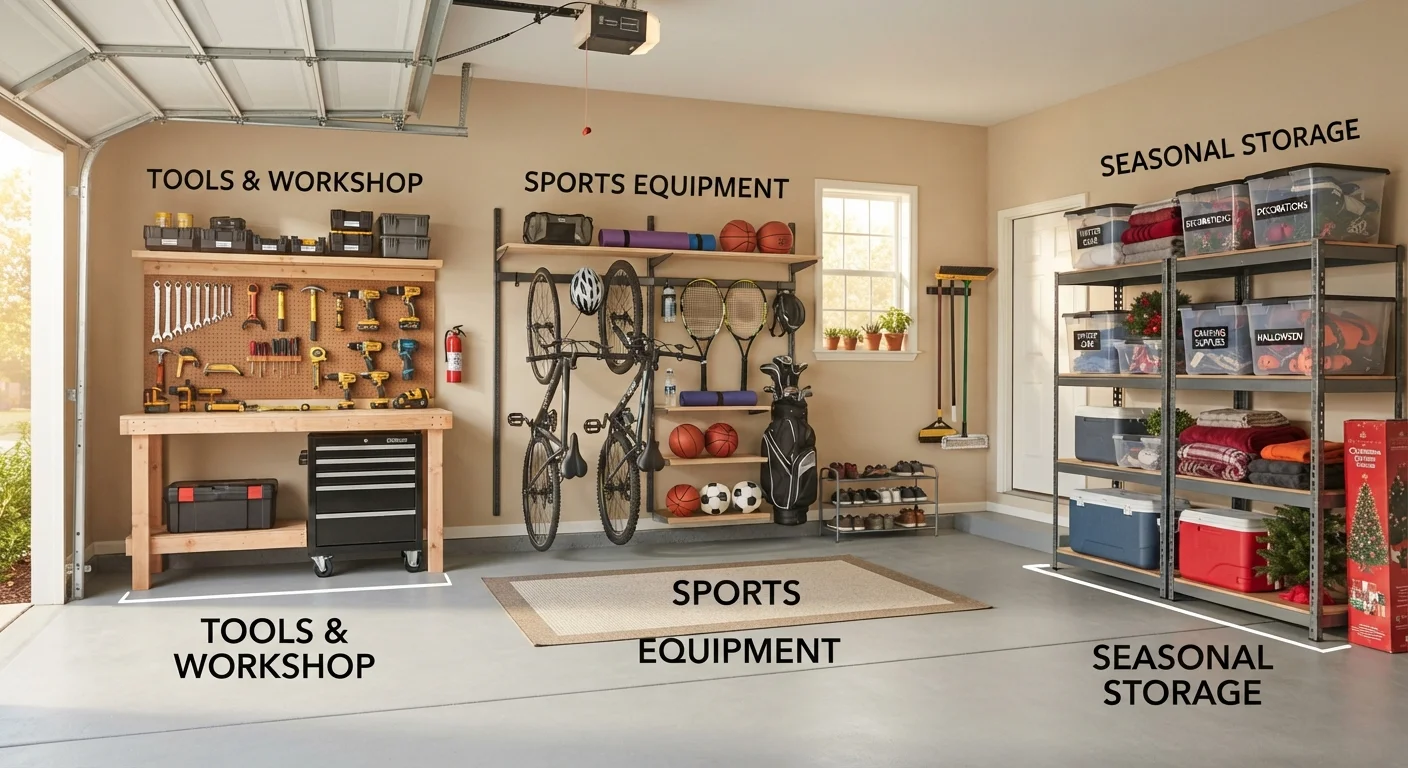
Why Garages Need a Framework Before They Need Shelves
Garages tend to become the household's catch-all because they lack defined rules about what belongs where. Bins and shelving units help, but only after a logical framework decides how space gets divided. As covered in our guide on storage containers and systems, buying products before building a plan is one of the most common-and costly-organizing mistakes.
Three zoning frameworks appear most often in garage organization: activity-based zones, category-based zones, and frequency-based zones. Each draws different boundaries around your space and suits different household realities. Understanding how they differ helps you pick the right starting point-or the right combination.
Start With a Usage Audit Before Moving Anything
Before committing to a framework, spend a week noting which items you actually reach for and which activities genuinely happen in the garage. Many garages are organized around aspirational habits-the camping gear that hasn't moved in three years-rather than real ones. An honest audit prevents you from building zones around things that don't need prime space.
Activity-Based Zones: Organize Around What You Do
Activity zoning carves the garage into dedicated areas for each pursuit that happens there: a workshop corner, a gardening station, a sports gear bay, a car maintenance area. Items live near the activity they support, regardless of what category they fall into. A workbench zone, for example, might hold both hand tools and safety glasses-two different categories-because both belong to the same task.
This approach works especially well when multiple household members use the garage for distinct, regular activities. Each person's zone stays intact and doesn't bleed into someone else's. The trade-off is that it requires clearly separate physical areas, which may not be feasible in a small or oddly shaped garage. It also demands that everyone agrees on which activities get dedicated space-a conversation worth having before you start moving things. For guidance on negotiating those shared-space decisions, see our piece on organizing homes with different household standards.
Category-Based Zones: Organize Around What Things Are
Category zoning groups items by type: all power tools together, all holiday décor together, all automotive supplies together. It mirrors how most people mentally search for things-"where do I keep the automotive stuff?"-which makes it intuitive for households that don't have dedicated activity areas.
This framework scales well in garages that are primarily storage rather than workspaces. It's also easier to maintain because adding a new item only requires identifying its category, not deciding which activity it belongs to. The downside: if you do multiple activities, you may find yourself crossing the garage to gather supplies from several zones before you can begin a task. Terminology like "zone-based storage" and related concepts are explained further in our home organization glossary.
| Activity-Based | Category-Based | Frequency-Based | |
|---|---|---|---|
| Core organizing logic | What you do in the space | What the item is | How often you use it |
| Best garage type | Workshop or multi-hobby garage | Primarily storage garage | High-traffic or entry garage |
| Ease of maintenance | Moderate - requires activity discipline | High - intuitive to return items | Moderate - requires honest use assessment |
| Works for multiple users | Yes, with agreed-upon zones | Yes, categories are universal | Depends on shared routines |
| Handles mixed storage well | Less ideal | Strong fit | Partial - items must be ranked |
| Setup complexity | Higher - needs physical space separation | Lower - follows existing mental models | Medium - requires usage audit first |
Frequency-Based Zones: Organize Around How Often You Reach for It
Frequency zoning assigns prime real estate-eye-level shelving, open floor space near the door-to items used daily or weekly. Seasonal items and rarely touched gear move to harder-to-reach spots: high shelves, back corners, overhead ceiling storage. The logic is purely about access time rather than what something is or what activity it supports.
This framework shines in garages that serve as the household's main entry point, or wherever people regularly grab things on the way out the door. It naturally reduces frustration because the most-reached-for items are never buried. Its limitation is that it can create a visually cluttered primary zone if many items qualify as "frequent," requiring honest self-assessment about actual usage patterns rather than aspirational ones.
55%
Americans with no room for cars in their garage
A U.S. Department of Energy study found that roughly half of American homeowners with garages cannot fit a vehicle inside due to stored items.
3x
More retrieval trips with poor zone placement
Organizing research consistently finds that misplaced storage zones significantly increase the number of steps needed to complete common household tasks.
Choosing One-or Blending All Three
In practice, most well-organized garages blend elements from all three frameworks. A homeowner might use activity zones as the top-level structure (workshop area, sports area, storage area), apply category logic within each zone (tools organized by type on the workbench), and then use frequency principles to position items within each category (most-used drill at eye level, specialty bits on a higher shelf).
Before committing to any approach, walk your garage with a notepad. Note what activities happen there, what broad categories you're storing, and which five items you grab most often. The pattern that emerges usually points clearly toward a primary framework. That starting point matters more than perfection-a consistent, simple system beats an elaborate one that nobody follows. If you're newer to organizing principles, the same layered logic applies to indoor spaces too; our closet organization guide walks through a comparable process from scratch.