Why a Room-by-Room Approach Works
Whole-home decluttering projects stall because they feel impossibly large. When you don't know where to start, you often don't start at all. Breaking the process into individual rooms creates a clear scope for each session, limits decision fatigue, and gives you a tangible win every time you finish a space.
This guide walks through each major room with a focused strategy, so you can work at your own pace without losing the thread. Whether you have a full weekend or just a few hours, the room-by-room structure keeps progress visible and momentum alive.
1 in 4
Americans report feeling overwhelmed by clutter
A UCLA Center on Everyday Lives of Families study found that clutter was a significant source of stress for many household members.
40%
Of household items rarely or never used
Professional organizers commonly estimate that a significant portion of items stored in the average home see little to no regular use.
Before You Begin: Set Up Your System
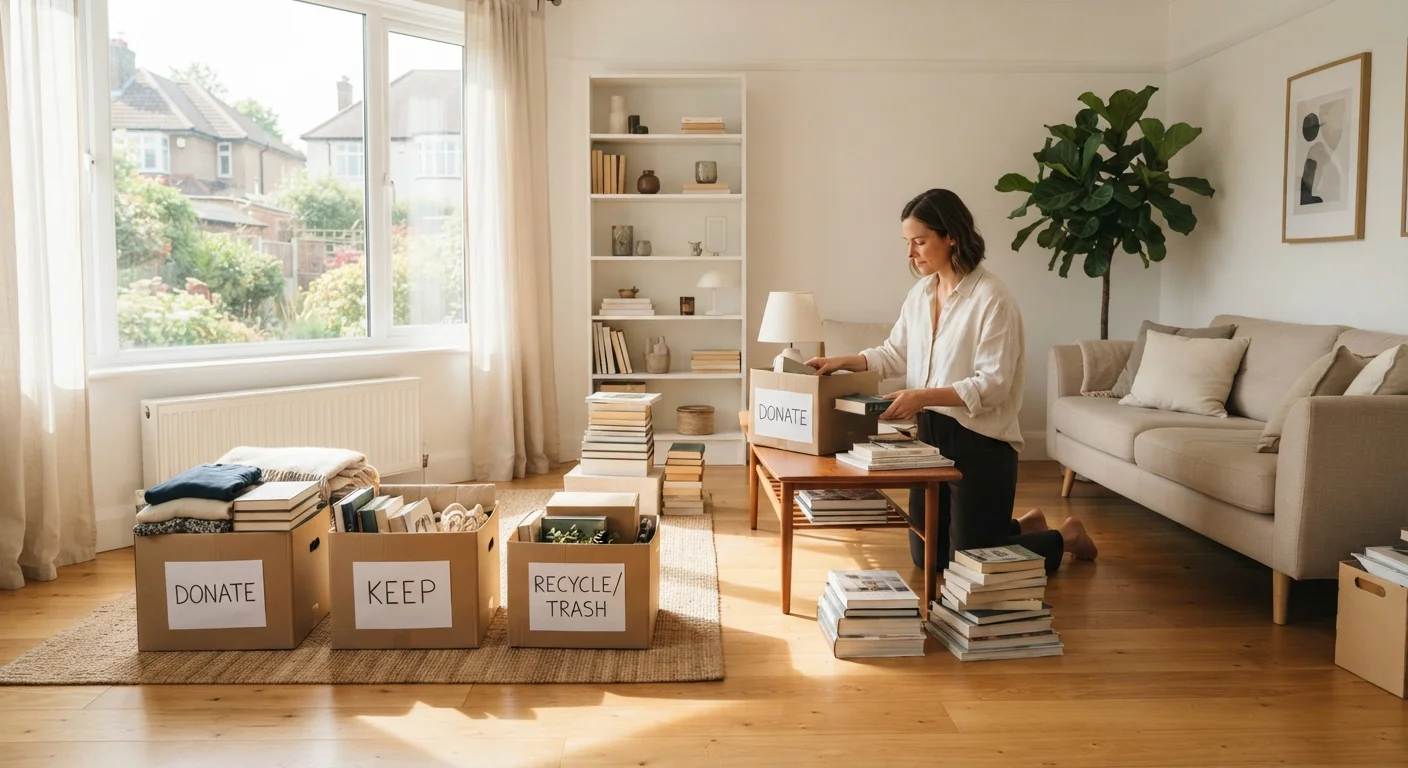
Before touching a single drawer, prepare four containers or designated areas: Keep, Donate, Discard, and Relocate (for items that belong in a different room). Having these ready eliminates mid-session hesitation.
Set a realistic time block - 60 to 90 minutes is sustainable for most people before fatigue sets in. Pick one room and commit to finishing it before moving on. Starting a second room before completing the first is one of the most common reasons decluttering efforts collapse.
Use a Timer to Stay Focused
Set a 60-minute timer before starting each room session. Working against a fixed end point reduces overwhelm and makes it easier to make quick keep-or-release decisions. When the timer goes off, wrap up your current category and stop - a partial room sorted is still genuine progress.
Kitchen: Start with Functionality
The kitchen works best when everything in it earns its place. Begin with cabinets and drawers: pull everything out, wipe the surfaces, and return only what you actively use. Duplicate gadgets, expired pantry items, and novelty tools that haven't been used in over a year are strong donation or discard candidates.
Countertops deserve special attention. A clear counter isn't just aesthetic - it makes cooking faster and cleaning easier. Keep only daily-use appliances on the surface; store the rest.
When evaluating kitchen gadgets, ask yourself: 'Could I replace this in under an hour if I needed it?' If yes, it's usually safe to let go.
This reframe shifts the question from abstract sentiment to practical replacement cost, making it easier to release items that feel 'useful' but rarely get used.
Pull everything out of one category - say, all spatulas or all mugs - before deciding what to keep. Seeing the full quantity at once makes redundancy obvious in a way that opening one drawer at a time never does.
Grouping by category rather than by location is a widely recommended decluttering method because it prevents duplicates from hiding across multiple storage spots.
For households wrestling with shared spaces and differing standards, our guide on organizing a home when everyone has different habits offers practical frameworks for building consensus.
Living Room: Clear the Common Ground
The living room accumulates clutter from everyone in the household, making it one of the hardest rooms to maintain. Focus first on surfaces - coffee tables, shelves, and side tables - since visual clutter there affects how the whole room feels.
Sort through media, books, and décor with a critical eye: keep what you use or genuinely love, and release the rest. Storage furniture with hidden compartments can help, but only if items inside have a clear home and are reviewed periodically.
Don't Declutter Other People's Belongings
In shared homes, only sort through items that are clearly yours. Donating or discarding a housemate's or family member's possessions - even with good intentions - can damage trust and create lasting friction. Focus your energy on your own belongings and shared neutral areas only when there is mutual agreement.
If your living room is part of a small apartment, constraints of small-space living can actually work in your favor by forcing more intentional decisions about what stays.
Bedroom and Closets: Your Personal Reset
The bedroom should be a low-stimulus space, yet it often becomes a dumping ground for laundry, unread books, and miscellaneous items with no permanent home elsewhere. Start with flat surfaces - the nightstand and dresser top - then move to under-bed storage, which tends to accumulate items that were never truly organized.
Closets are among the most impactful areas to address. Our closet organization guide walks through a complete method for emptying, evaluating, and rebuilding your closet system from the ground up - a worthwhile read before tackling yours.
Home Office and Paper Clutter
Paper is one of the most persistent sources of clutter in American homes. Mail, receipts, school forms, and old documents pile up quickly without a processing system. The key insight: paper clutter is rarely just accumulation - it signals a missing system for incoming documents.
Our article on paper clutter as a symptom explains how to address the root cause rather than clearing the same pile repeatedly. In the meantime, create three simple folders: Action (needs response), File (keep for records), and Shred/Recycle. Process new paper the day it arrives.
“A place for everything, and everything in its place. Without the first, the second is impossible.”
— Mrs. Isabella Beeton, 19th-century household management author, widely quoted in organization literature
Keeping It Decluttered Over Time
Decluttering once is a project. Staying decluttered is a practice. Two approaches dominate: the one-in, one-out rule (every new item brought in means one existing item leaves) and seasonal purges (scheduled reviews every few months). Each suits different household types - comparing these two decluttering rhythms can help you choose what fits your lifestyle.
For a structured seasonal approach, the Seasonal Home Reset Checklist provides a room-by-room audit designed to catch disorder before it compounds. And for the daily micro-habits that prevent clutter from rebuilding quietly, see our guide on habits that keep a home organized over time.
The goal isn't a perfect home - it's a functional one that supports how you actually live.
Seasonal Home Reset Checklist
A room-by-room seasonal audit that helps you catch and address disorder before it quietly compounds across your home.
Closet Organization From Scratch
A beginner-friendly walkthrough for emptying, evaluating, and rebuilding any closet into a system that actually holds up.
Paper Clutter Is a Symptom, Not the Problem
Explains the root causes behind document pileups and how to build a simple incoming-paper system that prevents recurrence.