The Pressure Is the Point
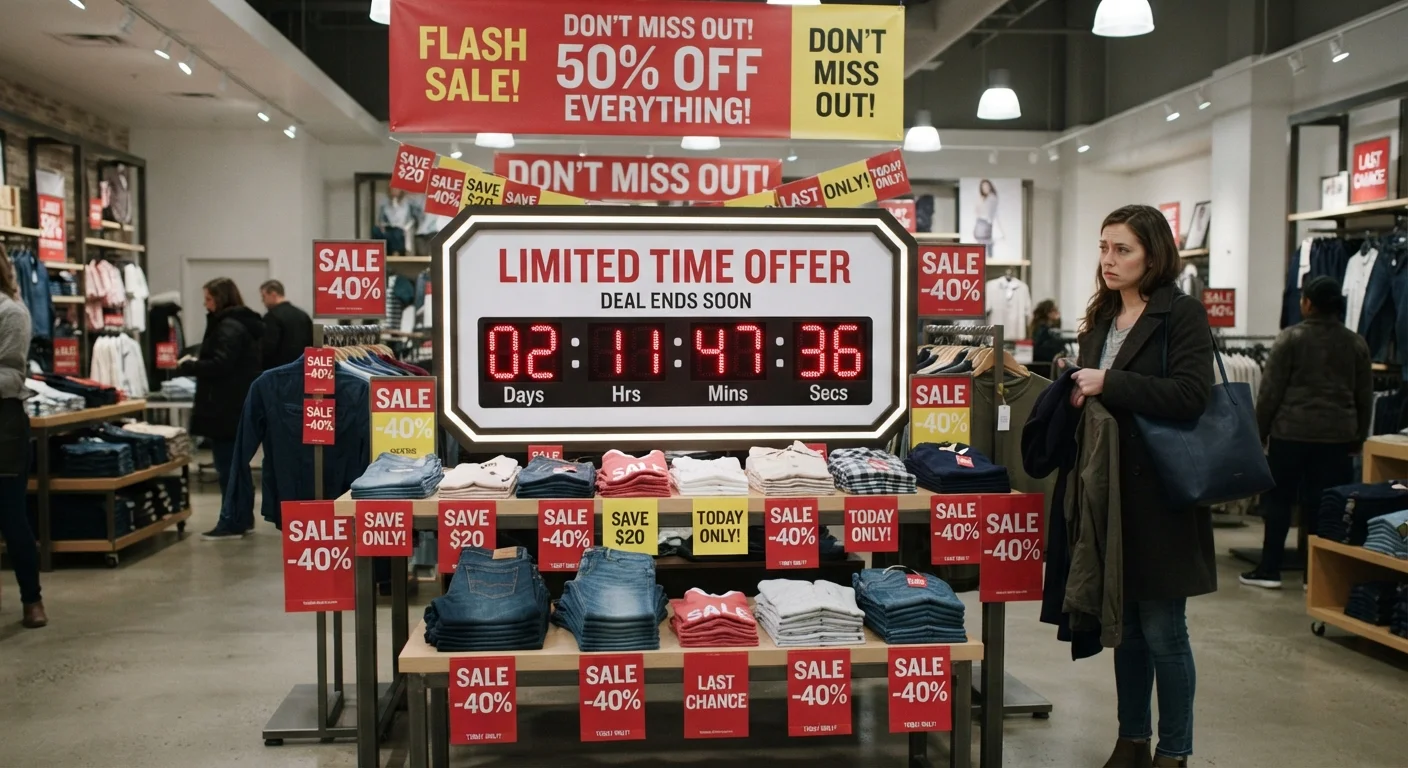
"Limited time offer" is one of the most common phrases in retail marketing, and also one of the least regulated in practice. The idea is straightforward: signal scarcity, trigger urgency, shorten the time a shopper has to think. Behavioral research has long confirmed that people make faster, less scrutinized decisions when they believe an opportunity is about to disappear.
What most shoppers don't realize is that the "limit" is frequently a marketing choice, not a logistical constraint. Prices can be quietly restored after a deadline passes, then the same promotion can reappear days later. Countdown timers on websites often reset the moment you reload the page. "While supplies last" language may apply to a warehouse with thousands of units in stock.
Understanding how these tactics work doesn't require cynicism - just a bit of context. See our breakdown of deceptive online deal tactics for a closer look at how these elements combine on a single product page.
Myth
If a deal has a countdown timer, the price will definitely go up when it hits zero.
Fact
Most countdown timers on retail and e-commerce sites reset automatically or are simply decorative - the price rarely changes at all.
Countdown timers are among the most widely studied urgency devices in e-commerce design. Independent tests by consumer journalists and price-tracking services have repeatedly found that a significant share of timers restart the moment a page is reloaded or revisited. The timer creates emotional pressure without any real commitment on the retailer's part. Before acting on a countdown, try refreshing the page or returning the next day - if the clock resets, you have your answer.
Myth
A 'limited time' sale means the item is genuinely discounted from its normal price.
Fact
The reference price a deal is marked down from may itself be inflated or rarely charged, making the apparent savings misleading.
Retailers sometimes set a high "original" or "compare at" price that the item was never consistently sold at, then apply a discount that looks impressive against that inflated baseline. This practice - sometimes called reference price inflation - has been the subject of class-action lawsuits and regulatory attention in several states. The most useful number to check is what the item has actually sold for over the past 30 to 90 days, which price history browser extensions can surface automatically.
Myth
If I don't buy during this promotion, I'll miss out and pay more later.
Fact
The same promotional price, or a lower one, typically recurs - especially on big-ticket items and consumer electronics.
Category-level pricing data shows that most consumer goods - appliances, electronics, apparel, home goods - cycle through similar discount levels multiple times per year. "Missing" a sale on a TV or kitchen appliance rarely means paying full price indefinitely; it usually means waiting a few weeks for the next comparable event. The urgency framing exploits the fear of regret, but the practical cost of waiting is almost always lower than the cost of buying impulsively at a price that wasn't the lowest available.
Myth
Online flash sales are strictly time-limited because stock is genuinely scarce.
Fact
"Flash sale" is a marketing format, not a supply constraint - many are extended, re-run, or applied to items with ample inventory.
While some flash sales do clear excess inventory under genuine time pressure, the format has become so common that it now functions primarily as an attention device. Retailers run recurring flash sales on the same SKUs, and "sold out" notices sometimes reflect artificial allocation rather than actual stock depletion. If an item disappears from a flash sale, checking the retailer's main catalog often reveals the same product available at a comparable or lower price through a standard listing.
Myth
Acting fast on a limited offer is smart shopping - hesitation costs money.
Fact
Rushed purchasing is one of the leading causes of buyer's remorse and unnecessary spending; a brief pause rarely costs anything.
The entire architecture of urgency marketing is designed to compress your decision window. But consumer behavior research consistently finds that a short delay - even 24 hours - significantly reduces impulse purchases without meaningfully increasing the price paid in the end. A simple habit: add the item to your cart or a wish list, close the tab, and return the next day. If the deal has genuinely expired, evaluate whether you still want the item at the new price. More often than not, a comparable offer is still available - or you've decided you didn't need it urgently after all.
What the Data and Rules Actually Say
The Federal Trade Commission (FTC) has guidelines that prohibit genuinely deceptive urgency claims - but the bar for enforcement is high, and most promotional language is vague enough to stay on the right side of the line legally. Phrases like "offer ends soon" or "limited availability" don't commit to specific dates or quantities, making them hard to challenge.
Price-tracking tools reveal a consistent pattern: many items sold under time-pressure promotions return to the same discounted price within days or weeks. This doesn't mean every promotion is fake - genuine clearance events, seasonal markdowns, and supplier-driven sales do exist. The problem is that the same visual language is used for both, making it nearly impossible to tell them apart at a glance.
~72%
Of 'sale' prices repeated within 30 days
A review of price-tracking data by consumer researchers found that roughly 72% of items promoted as limited-time sales returned to the same or lower price within a month.
9 in 10
Shoppers who've felt urgency pressure online
Surveys on e-commerce shopping habits consistently show the vast majority of online shoppers report feeling pressured by countdown timers or low-stock warnings.
If you're shopping online, it's worth knowing how promo codes and digital coupons interact with these promotions. Promo codes don't always stack or apply the way you'd expect, and a discount layered on an inflated "original" price may be less valuable than it looks.
Urgency Tactics Show Up in Subscriptions Too
Time-pressure language isn't limited to one-time purchases. Subscription sign-up flows frequently use "offer expires tonight" messaging to push consumers past the fine print on auto-renewal terms. Before accepting any time-pressured subscription offer, review the cancellation policy and billing cycle carefully. Reading the fine print on subscription services explains exactly what to look for before you commit.
For a broader look at how retailers construct the appearance of a deal, the anatomy of a fake sale walks through the full toolkit - from anchor pricing to manufactured scarcity. And if you want a complete framework for finding discounts that actually hold up, our complete guide to genuine discounts covers it end to end.