What the Envelope Method Actually Is
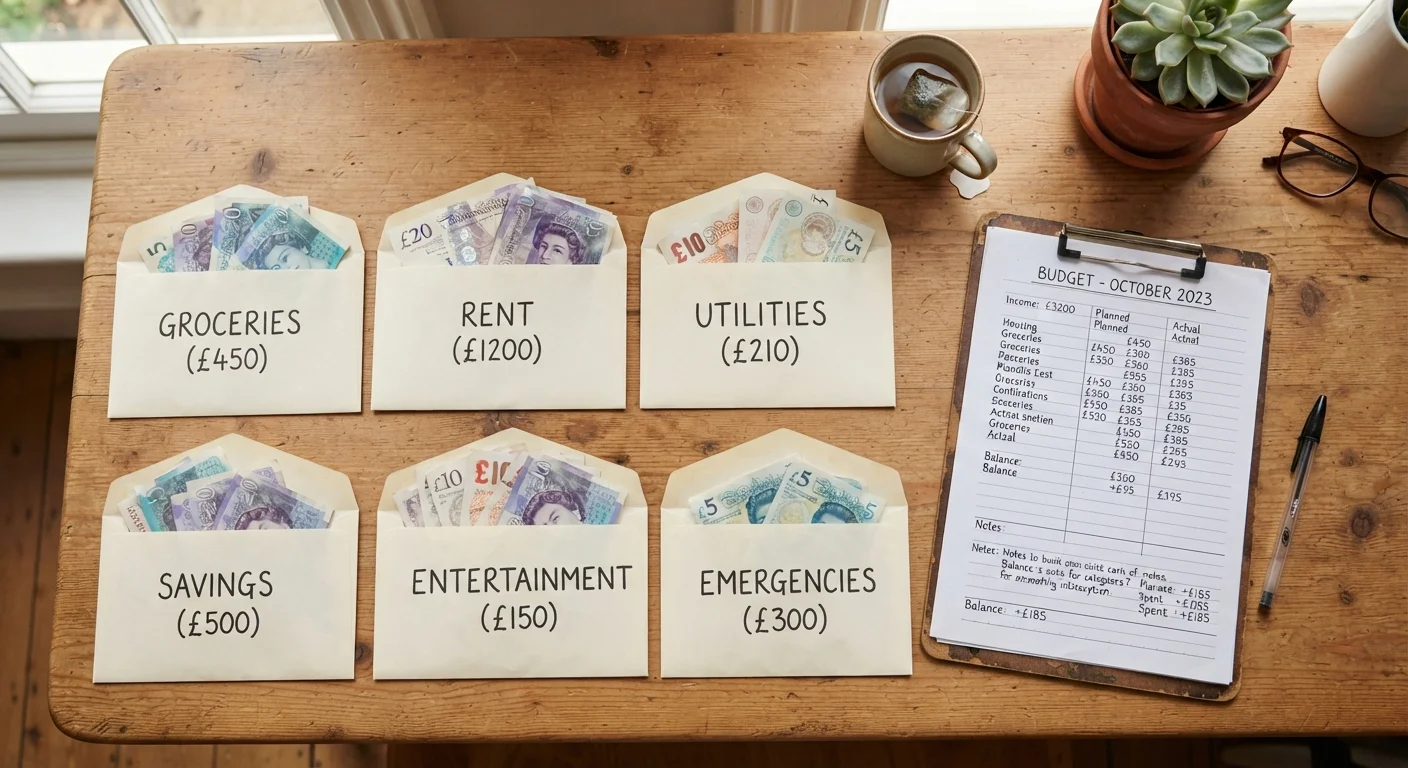
Cash envelope budgeting is straightforward: at the start of each pay period, you withdraw cash and divide it into labeled envelopes - one for groceries, one for dining out, one for gas, and so on. When an envelope is empty, spending in that category stops until the next pay period. Nothing more complicated than that.
The approach has been around for generations and has seen renewed interest as a counterweight to the ease of tap-to-pay and one-click checkout. It belongs to the broader family of zero-based budgeting, where every dollar gets a job. For a side-by-side comparison of how it stacks up against the 50/30/20 rule and other common frameworks, see how common budgeting methods compare.
Its appeal is simplicity. There is no app to configure, no bank integration to authorize, and no dashboard to interpret. The envelope either has money in it or it doesn't.
Where It Genuinely Helps
Makes overspending immediately visible
An empty envelope signals a hard stop in a way an app notification rarely does. The feedback is instant and requires no interpretation.
Reduces the abstraction of digital spending
Paying with physical cash registers as a real cost. Studies in behavioral economics suggest people spend less overall when transactions involve tangible money.
Zero setup cost or technology needed
No subscription, no app, no bank integration required. Anyone with envelopes and access to an ATM can start immediately.
Prevents category-level overspending automatically
Because each envelope is self-contained, overspending in one area cannot silently drain another - you have to make a conscious decision to transfer money between envelopes.
Builds spending awareness over time
Physically handling money each pay period forces a regular reckoning with where it goes, which can shift habits gradually without requiring detailed record-keeping.
The strongest case for the envelope method is psychological. Research in behavioral economics consistently finds that people spend more freely with cards than with cash - a phenomenon sometimes called the "pain of paying." Handing over physical bills registers as a loss in a way that a card tap simply doesn't. For households that know they overspend but can't seem to stop, that friction is the point.
The system also eliminates the lag between spending and awareness. With a bank account, you might not notice you've overdone it on restaurants until you check your balance three days later. With an envelope, you see the dwindling stack of bills in real time.
Finally, the setup cost is nearly zero. A pen, some envelopes, and a trip to the ATM is all it takes to start.
Where It Tends to Break Down
Lost or stolen cash is typically unrecoverable
Unlike a debit or credit card, cash carries no fraud protection. A stolen wallet empties the affected envelopes with no recourse.
Doesn't work for online or automatic payments
Subscriptions, bill autopay, and e-commerce purchases require a card or bank transfer, so a pure cash system is impractical for most modern households.
Forfeits card rewards on everyday spending
Households that would otherwise earn cash back or points on grocery and gas purchases give those benefits up entirely when paying with cash.
Inconvenient for frequent or varied transactions
Managing multiple envelopes, making exact-change purchases, and carrying cash for different categories adds friction to routine shopping trips.
Difficult to adapt for irregular income
Fixed envelope amounts assume a predictable paycheck. Freelancers and workers with variable income may find the rigid structure hard to calibrate pay period to pay period.
Risk of abandonment from day-to-day hassle
The method demands consistent discipline at every purchase. Even motivated adopters often revert to cards within a few months when the inconvenience outweighs the benefit.
The disadvantages are real and worth weighing honestly before you commit. Carrying meaningful amounts of cash creates a security risk - lost or stolen cash is generally gone for good, unlike a compromised debit card where many banks offer some protection. Online purchases, recurring subscriptions, and bill autopay simply don't fit the cash model, so most households end up running a hybrid system from day one whether they planned to or not.
There's also the opportunity cost of skipping card rewards. For a household spending several hundred dollars a month on groceries and gas, forgoing even a modest cash-back rate adds up over a year. That's not a reason to avoid the method if it's the only thing keeping your spending in check - but it's a trade-off worth naming.
For households with irregular income - freelancers, tipped workers, seasonal earners - the fixed-envelope structure can feel punishing during lean pay periods and awkward during flush ones. The honest trade-offs of strict budgeting covers this tension in more depth.
Making It Work in a Mostly Digital World
Most Americans can't go fully cash-based even if they want to. Landlords expect electronic transfers. Utilities run on autopay. Online shopping is sometimes unavoidable. The practical answer is to use envelopes only for the categories where you actually overspend - typically discretionary ones like dining, entertainment, and personal spending - while keeping fixed bills on autopay as usual.
You Don't Have to Go All-Cash
The envelope method doesn't require abandoning your bank account or credit cards entirely. Many households use physical envelopes only for two or three problem spending categories - like dining or entertainment - while keeping everything else digital. This hybrid approach captures most of the psychological benefit with far less day-to-day friction. It also sidesteps the security concern of carrying large amounts of cash.
If the cash-and-envelope routine feels too cumbersome, the underlying logic transfers to digital tools. Budgeting apps and spreadsheets can replicate the envelope structure with virtual categories that behave the same way - spending stops when the category balance hits zero. Applying envelope logic to a digital spending life walks through practical ways to do this. For a broader look at the tools available, digital tools for managing household finances offers a useful overview.
~18%
Higher spending with cards vs. cash
Multiple consumer behavior studies have found that people tend to spend roughly 15-20% more when using cards compared to cash for the same purchases, due to reduced perceived cost.
1 in 3
Americans with no working budget
Surveys conducted by financial literacy organizations have consistently found that roughly a third of U.S. adults do not follow any formal budget, regardless of income level.
Whether you go physical or digital, the method is only as good as your category setup. Vague buckets like "miscellaneous" defeat the purpose. Specific, honest categories tied to your actual spending history are what make the system click. If you're building a household budget from scratch, the complete household budgeting roadmap is a solid starting point.
This article is for general informational purposes only and does not constitute personalized financial advice. Consider consulting a qualified financial professional for guidance specific to your situation.