
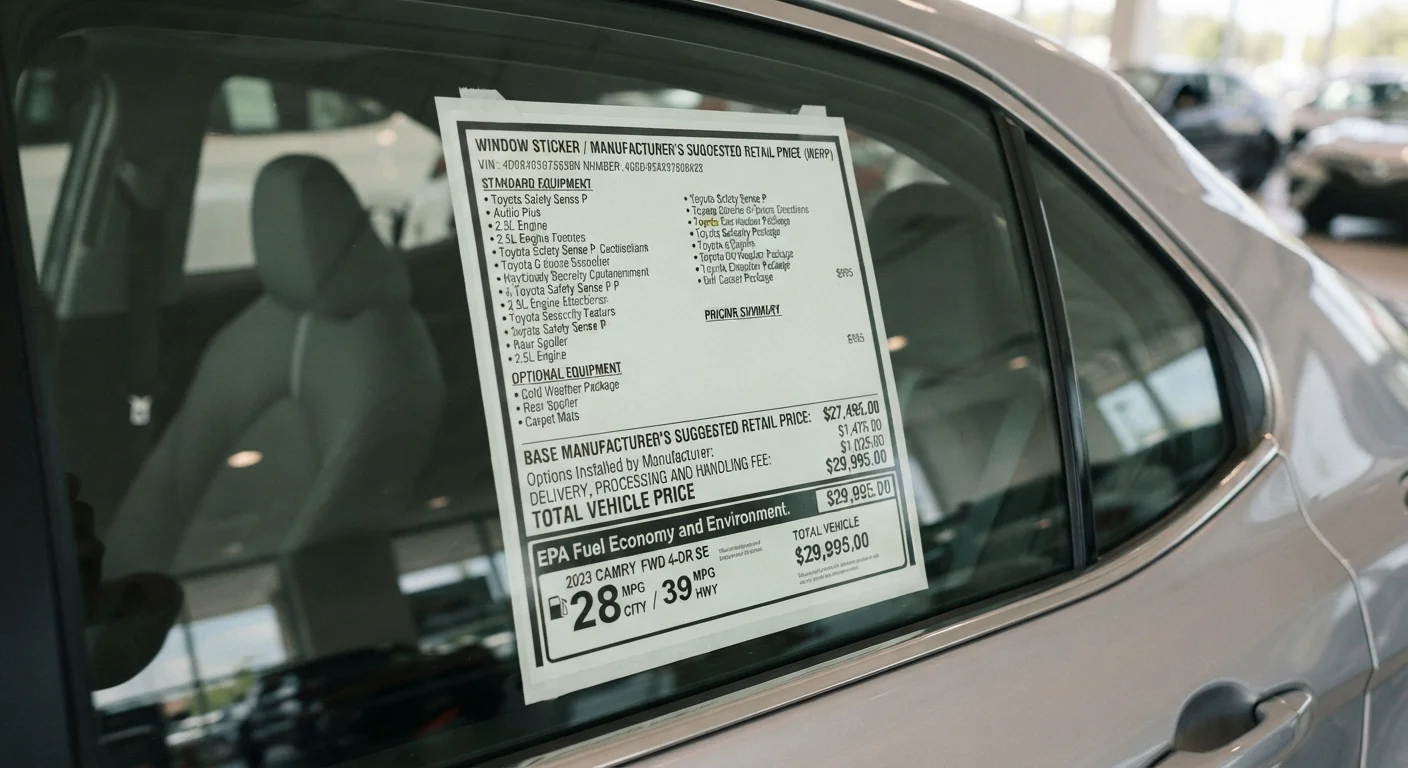
What Is a Monroney Sticker and Why Does It Exist?
The label affixed to every new vehicle's window is formally called the Monroney sticker, named after Senator Mike Monroney, whose 1958 Automobile Information Disclosure Act made it mandatory. Federal law requires every new car sold in the United States to display one, and removing it before sale - except by the buyer - is illegal. It exists specifically to give buyers a standardized, manufacturer-produced summary of what they're purchasing before any negotiation begins.
Understanding the sticker puts you on equal footing with the sales team. As part of the full car-buying process, decoding this document is one of the most reliable ways to separate manufacturer-set figures from dealer-influenced ones.
| Law requiring the sticker | Automobile Information Disclosure Act (1958) |
| Who produces the sticker | The vehicle manufacturer |
| Destination charge negotiability | Non-negotiable - set by manufacturer |
| Addendum sticker negotiability | Negotiable - set by dealer |
| Fuel economy figures source | U.S. Environmental Protection Agency (EPA) |
Section-by-Section Breakdown
The sticker is divided into distinct sections. Here's what each one communicates:
Vehicle Identification and Basic Info
The top portion lists the make, model, trim level, and the 17-character Vehicle Identification Number (VIN). The VIN encodes the factory of origin, engine type, and model year - details worth verifying independently. See what every VIN actually encodes for a full breakdown.
Standard Equipment
This section lists features included at the base trim level at no added cost - things like the infotainment system, safety tech, seating material, and powertrain. These items are not negotiable; they're built into the base MSRP.
Optional Equipment and Packages
Each factory-installed option or bundled package is listed with its individual price. These costs are added on top of the base price and contribute to the total MSRP. Packages are set by the manufacturer, not the dealer, so their prices on the sticker reflect the factory charge - not an arbitrary markup.
Manufacturer's Suggested Retail Price (MSRP)
The MSRP is the sum of the base price plus all factory options. The word suggested is meaningful: dealers are not legally required to sell at MSRP and commonly price above or below it depending on demand. MSRP is your negotiation anchor, not a fixed ceiling.
Fuel Economy Estimates
EPA fuel economy ratings - city, highway, and combined - appear on all new vehicles. These are estimates based on standardized test cycles and may differ from real-world results depending on driving habits, climate, and load.
Destination and Delivery Charge
This fixed fee covers the cost of shipping the vehicle from the factory to the dealership. It is set by the manufacturer and is non-negotiable - every buyer at every dealership pays the same amount for the same model regardless of geography.
MSRP vs. Invoice vs. Transaction Price
The Monroney sticker shows MSRP - what the manufacturer suggests. Invoice price is what the dealer nominally paid the manufacturer and is a separate document not shown on the sticker. The actual transaction price is what a buyer ultimately pays after negotiation, incentives, and trade-in adjustments. These three numbers are distinct and rarely identical.
Dealer-Added Options
Some stickers include a secondary label - sometimes called an addendum sticker - listing accessories installed by the dealership itself, such as window tint, cargo nets, or paint sealant. Unlike factory options, these are set by the dealer and are frequently negotiable. For a practical framework on evaluating these add-ons, see dealer add-ons at signing.
Monroney Sticker
The federally mandated window label on every new vehicle, produced by the manufacturer, disclosing the vehicle's features, pricing, and fuel economy. Removal before sale (except by the buyer) is a federal offense.
MSRP
Manufacturer's Suggested Retail Price - the total price recommended by the automaker, including base price and factory options. It serves as a starting reference, not a fixed selling price.
Addendum Sticker
A secondary label added by the dealership listing accessories or services installed after the vehicle left the factory. These charges are dealer-set and typically negotiable.
Destination Charge
A fixed, non-negotiable fee set by the manufacturer to cover transport of the vehicle from the factory to the dealership. All buyers of the same model pay the same amount.
EPA Fuel Economy Rating
Standardized fuel efficiency estimates (in miles per gallon) produced by the U.S. Environmental Protection Agency using defined test cycles. Real-world results may vary.
Base MSRP
The manufacturer's price for the vehicle in its standard trim configuration, before any optional packages or accessories are added.