Why Online Reviews Are Easy to Manipulate
Online reviews carry enormous influence over purchasing decisions. Research from consumer behavior studies consistently finds that a significant share of shoppers consult reviews before buying - which makes the review section a high-value target for manipulation. Methods range from straightforward paid-review schemes and incentivized campaigns to more sophisticated tactics like review trading networks and suppression of negative feedback.
Platforms invest resources in detection, but review fraud is an ongoing cat-and-mouse problem rather than a solved one. Understanding the mechanics behind manipulation helps you apply the right level of skepticism - not so much that you dismiss all reviews, but enough to avoid being misled. This is the same critical lens that's useful when spotting manufactured urgency in a sale.
Fake Reviews Are a Known Industry Problem
The U.S. Federal Trade Commission (FTC) has taken enforcement action against companies that purchase fake reviews or fail to disclose paid endorsements. This means the problem is real and documented - not just consumer paranoia. Treat reviews as one data point among several, not as definitive proof of quality.
How to Evaluate Reviews Step by Step
The following steps give you a repeatable process for assessing any product's review profile before you commit. You don't need special tools for most of these - just a methodical eye and a few extra minutes.
What you will need
Check the overall rating distribution
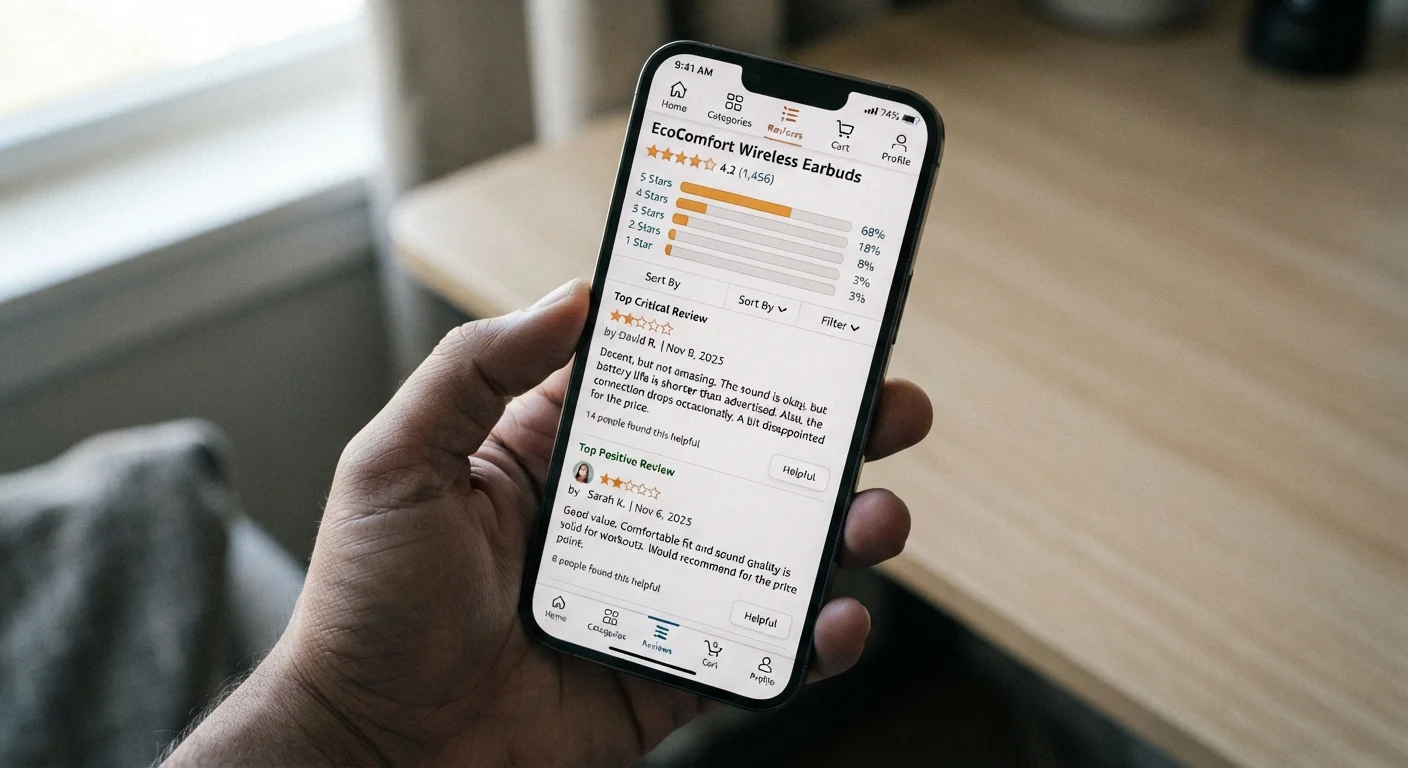
Open the full rating breakdown - the histogram showing how many reviews landed at each star level. A legitimate product usually has a mix: some fives, some fours, a scattering of threes, and a handful of ones and twos. If the chart looks like a "J-curve" with almost all reviews at five stars and a suspicious spike at one star (often left by people who never received the product), treat that as a red flag. Genuine products rarely satisfy everyone equally.
Sort by most recent and look for bunching
Switch the sort order to "most recent" and scroll through the timestamps. A sudden flood of five-star reviews posted within the same week - especially after a long quiet period - suggests a coordinated campaign. Organic reviews tend to arrive at a steady, irregular pace that mirrors actual purchase volume. Unusual spikes around a product launch or a price drop deserve extra scrutiny.
Read for specificity, not enthusiasm
Genuine reviews tend to mention concrete details: dimensions that mattered, a specific feature that worked well or failed, how the product compared to an expectation. Fake reviews lean on generic superlatives - "Amazing product!!! Life-changing!!!" - without any substance. Scan for answers to questions like: What did this person actually do with the product? What surprised them? What would they change? Absence of specifics is a reliable tell.
Click through to the reviewer's profile
Most major platforms let you view a reviewer's history. A credible reviewer typically has a varied track record across different product categories over a span of time. Be cautious if a profile has reviewed dozens of unrelated products in the same week, or if every single review they've ever left is five stars. Real consumers have mixed experiences; a reviewer who is universally delighted by everything is not reviewing - they're advertising.
Cross-reference with off-platform sources
Search for the product name alongside terms like "review" or "problems" on a general search engine. Independent blogs, forum threads, and consumer advocacy sites are harder to manipulate than a single retailer's review section. Third-party review aggregators compile data from multiple sources and can surface patterns the platform itself may not highlight. This is especially useful for higher-cost purchases where the risk of a bad decision is higher. You can apply the same approach when evaluating an app before downloading it.
Weigh the one-star reviews carefully
Low ratings are worth reading closely but should be evaluated for relevance. A one-star review complaining about slow shipping is a logistics complaint, not a product quality complaint. Sort one-star reviews by helpfulness and look for recurring themes: the same flaw mentioned by multiple independent reviewers carries far more weight than a single outlier. Repeated mentions of the same problem - a battery that dies quickly, a clasp that breaks - are the signal you actually need.
Filter for Mid-Range Ratings First
Three-star reviews often contain the most balanced, specific feedback. Reviewers at this level typically explain what worked and what didn't without the emotional extremes of one-star complaints or five-star enthusiasm. Starting here gives you a realistic baseline before reading the outliers.
Once you've completed your review evaluation, fold it into a broader pre-purchase routine. The Smart Shopper's Pre-Purchase Checklist covers additional factors - seller credibility, pricing patterns, and return policies - that work alongside review analysis to give you a complete picture. You might also want to review what makes an online seller trustworthy before finalizing any purchase from an unfamiliar retailer.