Why Retailers Design Tags to Guide Your Attention
A retail price tag is built around one primary goal: communicating a price clearly enough that you pick the item up. Everything beyond that-unit pricing, date codes, color signals-is secondary to the store, even if it's primary to you as a buyer.
Stores invest significant effort in what researchers call price presentation: how a number looks, what it is compared against, and what surrounds it. Charm pricing (prices ending in .99 or .95) is among the most documented examples-studies in consumer psychology consistently find that prices ending just below a round number tend to feel substantially lower than they are. A $19.99 price tag registers closer to $19 than $20 in most shoppers' mental accounting, even when people know the effect exists.
Reference prices and promotional framing operate on similar logic. The goal of a strikethrough price is to make the current price feel like a win regardless of whether the original was a meaningful baseline. Our article on common retail sale terms breaks down the vocabulary that surrounds these tactics, from 'doorbuster' to 'clearance.'
None of this means stores are acting improperly-it's simply how pricing is communicated in retail environments. Understanding the structure lets you step back from the presentation and evaluate the numbers themselves.
Combine Tag Reading With a Pre-Purchase Check
After decoding the tag in the store, cross-reference the unit price and item code against online listings before you commit. Our Smart Shopper's Pre-Purchase Checklist walks through that full process in a few minutes.
What the Tag Actually Contains
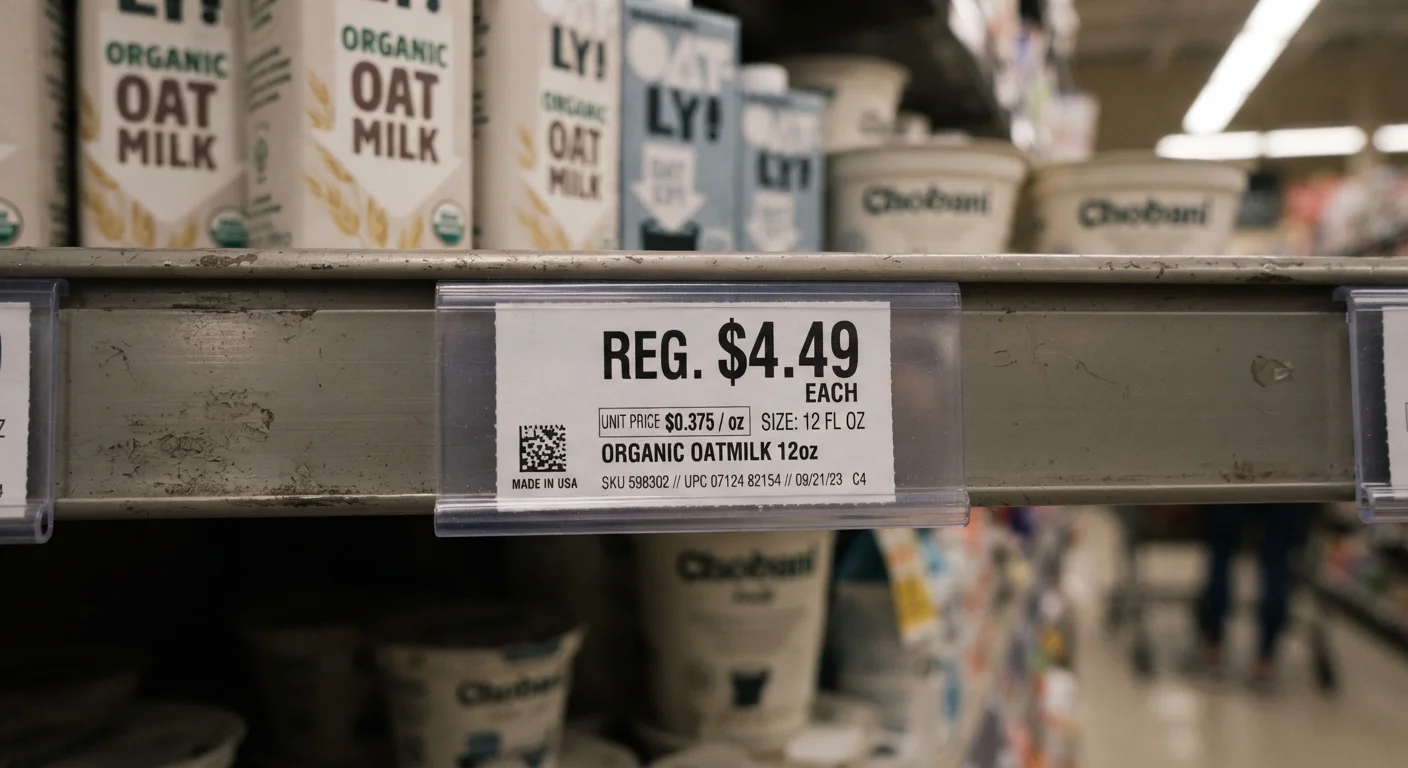
A typical grocery or big-box shelf label can contain up to six distinct data points: the item name, the selling price, the unit price, a date, a department or category code, and an item SKU or internal code. Most shoppers read only the first two.
Each of the others carries useful information. The unit price is the most actionable for comparison shopping-particularly in grocery contexts where package sizes vary widely. For more on how package-size manipulation affects what you actually pay per use, see our piece on what drives grocery bill increases.
Strikethrough Prices Are Not Neutral Facts
Retailers are generally permitted to set their own 'original' or 'regular' prices, which means a crossed-out price may reflect a figure that was charged briefly, seasonally, or at a different store entirely. Federal and state rules on reference pricing vary and are not always strictly enforced. Always treat a strikethrough price as a starting point for scrutiny, not proof of savings. For a deeper look at how this tactic works, see how retailers manufacture urgency.
Date codes tell a different story depending on the product category. On perishables, they relate to freshness. On non-perishables and general merchandise, they typically indicate when the current pricing was applied-useful context when evaluating whether a sale is recent or has been running for months.
Color coding and letter suffixes are the least standardized element on a tag, but in stores where you shop regularly they are worth learning. Once you know what a .97 ending or a bright yellow border means at your local chain, you can spot clearance and end-of-line items before they're promoted to the main aisle. After reading tags, use the pre-purchase checklist to confirm whether what you found is worth acting on.
Find the unit price, not just the package price
Most grocery and household goods shelf tags include a unit price-a smaller number showing cost per ounce, per count, per fluid ounce, or per some other standard measure. This is the figure that lets you compare a 12-pack against a 6-pack, or a store brand against a name brand, on equal footing.
If the tag doesn't display a unit price, divide the package price by the total quantity (ounces, units, etc.) yourself. A $4.80 bottle containing 16 fl oz costs $0.30 per fl oz; a $3.50 bottle with 10 fl oz costs $0.35 per fl oz. The pricier-looking package is actually cheaper per use.
Check for a markdown or print date
Many price tags-especially on meat, produce, and perishables-include a date that tells you when the current price was applied. A markdown date is not an expiration date and is not a guarantee the price will hold until a certain point. It simply tells you how long ago the discount was set.
For non-perishables, a markdown date on a shelf label can indicate how recently the item moved from full price to a sale price. Tags that were marked down weeks ago and are still sitting on shelves may signal slow-moving inventory rather than a carefully timed promotion.
Decode tag color and letter codes
Large chain retailers often use color-coded tags or alphanumeric codes to communicate markdown status to staff-and sometimes to attentive shoppers. A yellow tag frequently indicates a sale, while a red tag often signals clearance. Some retailers use specific letters or suffixes on the price (like a price ending in .97 or .00 instead of .99) as internal signals that an item won't be restocked.
These systems are retailer-specific and are not standardized across the industry, so treat any pattern you notice as a starting hypothesis rather than a confirmed rule. When in doubt, ask a store associate to interpret what the tag colors or codes mean in that location.
Scrutinize the reference ('original') price
When a tag shows a struck-through price alongside the current price, that reference price is typically set by the retailer and may reflect a range of things: the manufacturer's suggested retail price (MSRP), a price charged briefly at a different location, or a figure that was technically 'in effect' for a minimum period required by local law.
A useful habit: look up the item's price history using a price tracking tool before deciding whether the markdown represents a genuine reduction. You can also cross-check how inflated original prices work online - the same mechanics apply in physical stores.
Note the item's SKU or store code for follow-up
Every shelf tag carries a SKU (stock-keeping unit) or item code. Photographing or writing this down takes seconds and makes it easy to look up the same product online to verify pricing, read reviews, or check whether a competitor carries the same SKU at a lower price.
This step is especially useful when you are buying something unfamiliar or expensive, since the item code eliminates ambiguity about whether the online listing you find matches exactly what is on the shelf.
Putting It Together at the Shelf
The full process takes under a minute once it becomes habit. Glance at the unit price first-if the tag doesn't show one, calculate it. Check for a markdown or print date. Notice the tag color or any price-ending convention you've observed at that store. If there's a reference price, treat it as a number to verify rather than a given. And when it matters, photograph the SKU for a later check.
These habits won't require a spreadsheet or a price-tracking app for every trip. For routine grocery and household purchases, the unit price comparison alone is usually enough to make a sound call in the aisle. For larger discretionary purchases, pairing tag reading with a quick look at how price tracking tools work adds another layer of verification without much extra time. The same critical lens applies beyond the store-see how common online shopping habits drain budgets when price tags are replaced by digital displays.
Color Codes Vary by Retailer
There is no industry-wide standard for tag color systems. What signals 'final clearance' at one chain may mean something different at another. If you're unsure, ask a store associate what the tag colors mean at that specific location rather than assuming.
This article is for general consumer education purposes. Retail pricing practices, labeling laws, and store-specific conventions vary by retailer, region, and product category. Verify details with store staff or official sources when making significant purchasing decisions.