How the Two Channels Work
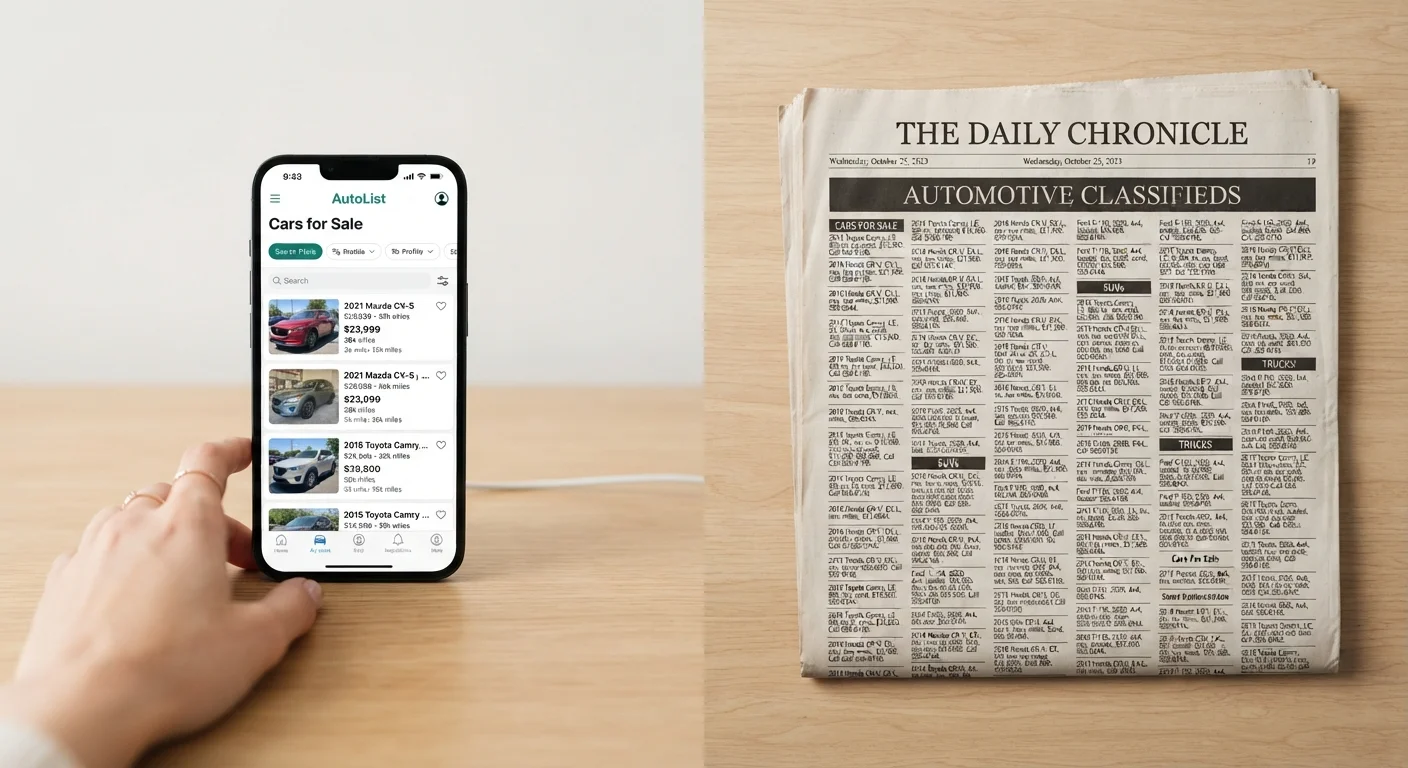
Online car marketplaces are centralized platforms where sellers create detailed listings - with photos, vehicle history, pricing, and contact options - that are indexed and searchable by buyers across the country. These platforms typically use algorithmic matching to surface listings to relevant searchers, and many integrate valuation tools so sellers can benchmark their asking price against comparable vehicles.
Local classified ads, whether printed in a regional newspaper or posted to community-focused online boards, serve a geographically bounded audience. Listings tend to be simpler - a description, a price, and contact information - and the implied expectation is that buyer and seller will meet locally to inspect and complete the transaction in person.
Understanding the full arc of a vehicle sale - from pricing research to paperwork - is covered in our guide to the full lifecycle of a car transaction.
Audience Reach and Buyer Quality
The most significant structural difference is audience size. Online marketplaces draw buyers from across the country, which directly increases the probability of finding a buyer willing to pay close to asking price. For uncommon trims, low-production models, or specialty vehicles, this national reach can be decisive - a locally rare configuration may have dozens of interested buyers in other states.
Local ads attract a smaller but often more transaction-ready pool. Buyers contacting a local seller have usually already decided they want to transact in person, which can reduce the number of inquiries that go nowhere. However, a smaller audience means fewer competing offers, which can limit a seller's pricing leverage.
| Online Marketplace | Local Classified Ads | |
|---|---|---|
| Buyer pool size | National, very large | Regional, limited |
| Typical listing detail | Photos, history, specs, price tools | Basic description and price |
| Pricing leverage | Higher - national comparables | Lower - regional demand only |
| Transaction speed | Variable - more inquiries to filter | Often faster once buyer found |
| Fraud risk | Higher - payment and identity scams | Lower - in-person exchange |
| Logistics complexity | Can involve shipping, remote title transfer | Local handoff, simpler paperwork |
| Best vehicle fit | Niche, specialty, or common models | Common local-demand vehicles |
For sellers weighing the broader question of private sale versus dealership trade-in, our comparison of private party sales and trade-ins examines the time and money trade-offs in detail.
Pricing, Speed, and Transaction Complexity
Online platforms make it easier to set a defensible asking price because sellers can review comparable active and recently sold listings at scale. Integrated valuation tools reflect national supply and demand, which can be an advantage or a disadvantage depending on whether local market conditions are above or below the national average.
Local listings often close faster in terms of calendar days from first contact to handoff, because fewer logistical steps are involved - no shipping coordination, no out-of-state title transfer complexity, and payment is typically cash or a cashier's check exchanged in person. The tradeoff is that a thinner buyer pool may mean waiting longer for the right local buyer to appear, or accepting a lower offer.
List in Both Channels Simultaneously
There is no rule requiring a seller to choose one channel exclusively. Posting the same vehicle on an online marketplace and a local classified board at the same time costs little additional effort and broadens exposure. If a local buyer makes a solid offer quickly, the online listing can simply be removed. Many sellers find this dual approach reduces time on market without requiring price concessions.
First-time private sellers often underestimate how much listing quality affects both speed and price. Our article on common mistakes first-time sellers make covers what to watch for before you publish any listing.
Risk, Fraud, and Safety Considerations
Both channels carry risk, but the nature of those risks differs. Online marketplace transactions introduce exposure to payment fraud - counterfeit cashier's checks, overpayment scams, and phishing through fake buyer profiles are documented and recurring patterns. Sellers should treat any buyer who requests unusual payment arrangements or proposes a third-party escrow service as a warning sign worth investigating carefully.
Local classified transactions reduce some digital fraud vectors but introduce in-person safety considerations. Meeting strangers to show a vehicle carries its own risks. Practical precautions include conducting test drives and initial meetings in well-lit, public locations - many local police departments maintain designated safe exchange zones for this purpose - and bringing another person along.
Watch for Payment Scams on Online Listings
Fraudulent buyers on online platforms commonly propose overpayment schemes, fake escrow services, or cashier's checks that clear initially but are later reversed by the issuing bank. Sellers who release a vehicle before confirming payment is truly settled can be left with neither the car nor the funds. Cash, verified wire transfer, or payment confirmed directly with your bank before handoff are the safest options.
Regardless of channel, sellers should verify that all paperwork - title transfer, bill of sale, odometer disclosure - is completed correctly. Errors or omissions can create legal and financial exposure that outlasts the sale itself.