Why the Paperwork Matters
A private car sale is a legal transfer of property, not just an exchange of keys. Without the correct documents, a seller can remain on the hook for a vehicle they no longer own - including any tickets, accidents, or fees incurred after the sale. A buyer who skips document verification risks purchasing a car with a hidden lien, a salvage title, or a VIN that doesn't match records.
Understanding each document's role is foundational to completing a clean transaction. For a broader look at how this fits into the full arc of ownership, see our complete ownership roadmap. And if you're still weighing whether to sell privately at all, compare both routes before committing.
| Federal odometer law applies to | Vehicles under 10 years old (with some exemptions) (Federal Odometer Act, 49 U.S.C. § 32705) |
| Typical title transfer deadline | 10-30 days after sale (varies by state) (Individual state DMV regulations) |
| States requiring notarized title | Roughly a dozen, including Louisiana, Maryland, and Montana (AAMVA state titling guides) |
| Core documents in every private sale | Title, bill of sale, odometer disclosure |
| Lien release required when | Vehicle has an outstanding auto loan |
| Where to verify state-specific forms | Your state's DMV or motor vehicle authority website |
The Core Documents Explained
Certificate of Title
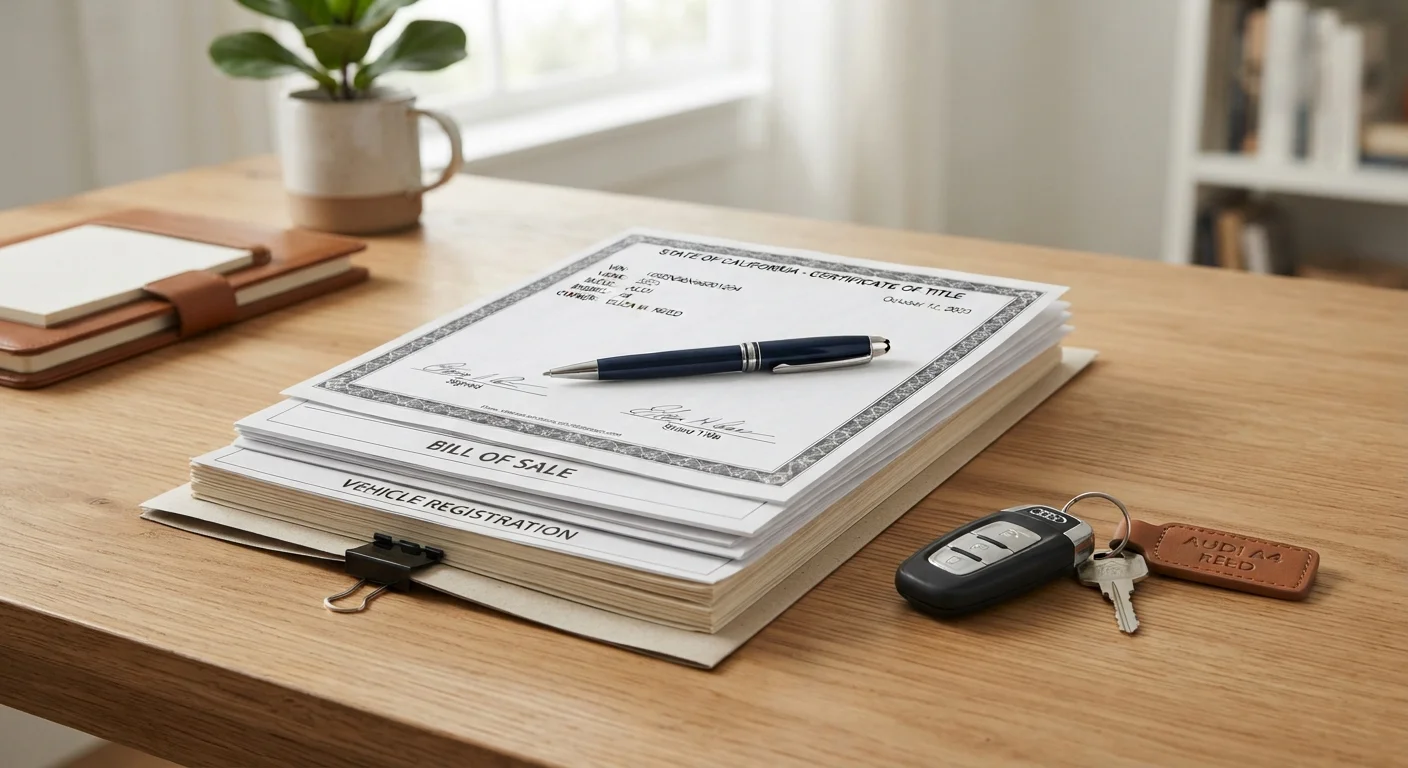
This is the most critical document in any private sale. The seller must sign the title over to the buyer on the designated lines - typically a seller signature, buyer information, sale price, and odometer reading. Some states require a notary to witness this signing. If the title is lost, the seller must obtain a duplicate from the DMV before the sale can proceed legally.
Bill of Sale
A bill of sale records the transaction's details: both parties' names and addresses, the vehicle's year, make, model, and VIN, the sale price, and the sale date. Even where not legally required, it protects both parties - the seller can prove what price was agreed upon, and the buyer has documentation of the purchase. First-time private sellers frequently skip this step and later regret it.
Odometer Disclosure Statement
Under federal law, sellers of most vehicles under 10 years old must disclose the vehicle's mileage in writing. Many states print this directly on the back of the title; others use a separate federal form (Form NHTSA-5). Intentionally falsifying mileage is a federal crime.
Lien Release
If the seller financed the vehicle and still has an outstanding loan, the lender holds the title. The loan must be paid off before or at the time of sale, and the lender must provide a written lien release. Without this document, the buyer cannot obtain a clean title in their name.
State Requirements Vary Significantly
No single document checklist applies uniformly across all 50 states. Some states have additional mandatory forms (such as smog certificates or safety inspection records), while others integrate the odometer disclosure directly into the title. Always verify requirements with your specific state's motor vehicle authority before completing a sale.
Additional Documents by Situation
Beyond the core set, certain situations call for additional paperwork.
- As-Is Disclosure: Recommended in most private sales to confirm the buyer accepts the vehicle's current condition. Some states require this explicitly.
- Vehicle History Report: Not a legal requirement, but providing one builds trust and reduces post-sale disputes. Learn how to read a vehicle history report so both parties understand what the report reveals.
- Smog or Emissions Certificate: Required in California and several other states before a title can transfer to a new owner.
- Power of Attorney: If the seller cannot be present in person to sign the title, a limited or vehicle-specific power of attorney may allow a designated representative to sign on their behalf (rules vary by state).
- Release of Liability: Filed with the DMV by the seller immediately after the sale. This notifies the state that the seller no longer owns the vehicle, protecting them from future liabilities.
For everything related to being a well-prepared owner, the Car Ownership Basics hub is a useful ongoing reference.