Why This Decision Is Harder Than It Looks
The instinct to replace a car after a large repair bill is understandable, but it often leads to a financially worse outcome. A replacement vehicle-whether new or used-comes with its own costs: a monthly payment, higher insurance premiums, sales tax, registration fees, and immediate depreciation. Understanding how depreciation shapes ownership decisions is essential before assuming a newer car is automatically the better deal.
At the same time, pouring money into a vehicle with cascading problems is a real trap. The goal is to assess both paths honestly, not to default to one or the other.
| Factor | Favors Repair | Favors Replacement | |
|---|---|---|---|
| Repair cost vs. vehicle value | Below 50% of market value | At or above 50% of market value | |
| Maintenance history | Consistent, documented upkeep | Spotty or unknown history | |
| Loan/payment status | Vehicle is paid off | Already carrying payments | |
| Nature of the problem | Single, isolated system failure | Multiple systems failing at once | |
| Safety systems affected | Non-critical component (e.g., AC) | Brakes, steering, or structure | |
| Vehicle mileage/age | Moderate miles, strong engine health | Very high miles, multiple worn systems |
The 50% Rule and Its Limits
A commonly cited benchmark among automotive advisors is the 50% rule: if a single repair estimate exceeds 50% of the vehicle's current market value, replacement is worth serious consideration. For example, a $2,000 transmission job on a car worth $5,000 passes that threshold; the same repair on a $15,000 car does not.
Market value can be estimated using publicly available tools such as Kelley Blue Book or the NADA Guides-resources that reflect real transaction data rather than asking prices. Keep in mind that the rule is a starting point, not a verdict. A car with 80,000 miles, a clean maintenance record, and no other known issues may be worth repairing even when a single job crosses that line. Context always matters.
Get the Repair in Writing Before Deciding
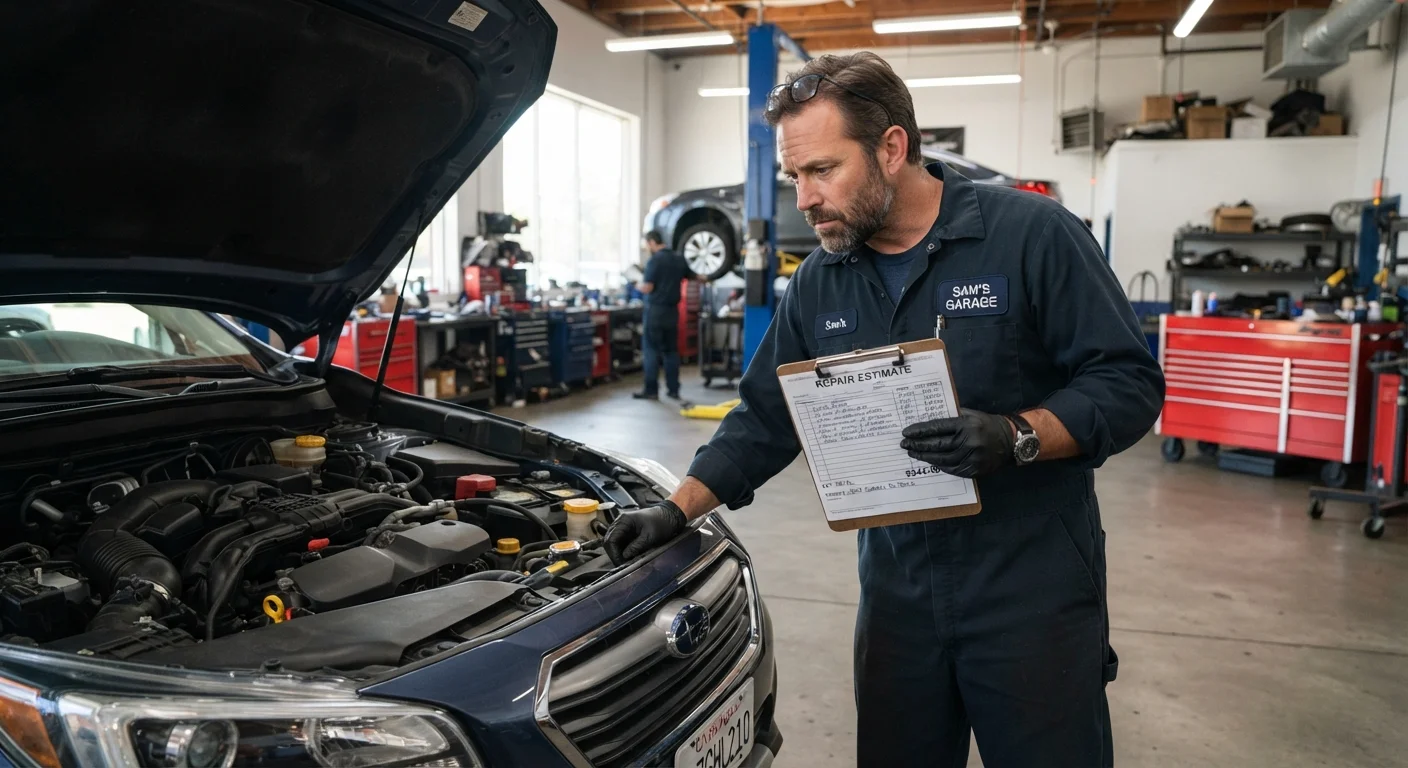
Before committing to either path, ask your mechanic for a written estimate that separates parts from labor. This lets you comparison-shop the parts cost independently and gives you a concrete number to weigh against replacement. A verbal ballpark figure isn't sufficient for a decision of this size.
When Repairs Almost Always Make Sense
Certain scenarios tilt the math firmly toward repairing:
- The car is paid off. Eliminating a monthly payment is a significant financial advantage. Even a $1,500 repair can be cheaper than 12 months of car payments.
- The vehicle has a strong maintenance history. A car that has been maintained consistently tends to have fewer cascading problems. One expensive repair on an otherwise sound vehicle is different from one repair in a long string of them.
- The repair is isolated. Replacing a water pump or alternator on an otherwise reliable car is a bounded cost. Compare that to the open-ended expenses of a different vehicle.
$9,282
Average annual new-vehicle ownership cost
According to AAA's Your Driving Costs study, new vehicle ownership costs-including depreciation, financing, and insurance-average over $9,000 per year.
~$1,500
Median annual car repair spending per vehicle
The Consumer Expenditure Survey from the U.S. Bureau of Labor Statistics reports average household vehicle maintenance and repair spending in roughly this range annually.
When Replacement Deserves a Serious Look
Replacement becomes more defensible under these conditions:
- Repairs are recurring and compounding. Multiple systems failing in a short window-transmission, suspension, cooling-signals deeper wear that one repair won't resolve.
- The repair affects safety-critical systems and the estimate is very high. Brake system failures, steering rack problems, or significant structural damage require immediate attention. If the repair cost is prohibitive relative to the vehicle's worth, continuing to drive the car safely may not be realistic.
- The car's market value has fallen sharply. High mileage, collision history, and age all compress value. When a car is worth very little, even modest repairs can exceed its replacement cost at the lower end of the used market.
For drivers rethinking their broader transportation setup, it's also worth reviewing the full picture of transportation costs before committing to a new vehicle payment.
Getting the Information You Need to Decide
A single mechanic's estimate isn't always enough. Getting a second opinion on major repairs-particularly powertrain or electrical work-is a reasonable precaution. Ask the shop to break down labor versus parts costs; labor is often the larger variable and may differ significantly between independent shops and dealerships.
If you're considering a used replacement vehicle, factor in the potential value of an extended warranty and what it actually covers. And if your household is weighing whether a second vehicle is even necessary, the trade-offs of one car versus two are worth examining carefully before adding another set of fixed costs.
The repair-or-replace question ultimately comes down to a comparison of two ownership paths-not just two price tags. Running those numbers fully, with real estimates in hand, is the only way to make a decision you won't second-guess.