Defining the Two Styles
Before comparing outcomes, it's worth being precise about what each style actually involves - because both terms get used loosely.
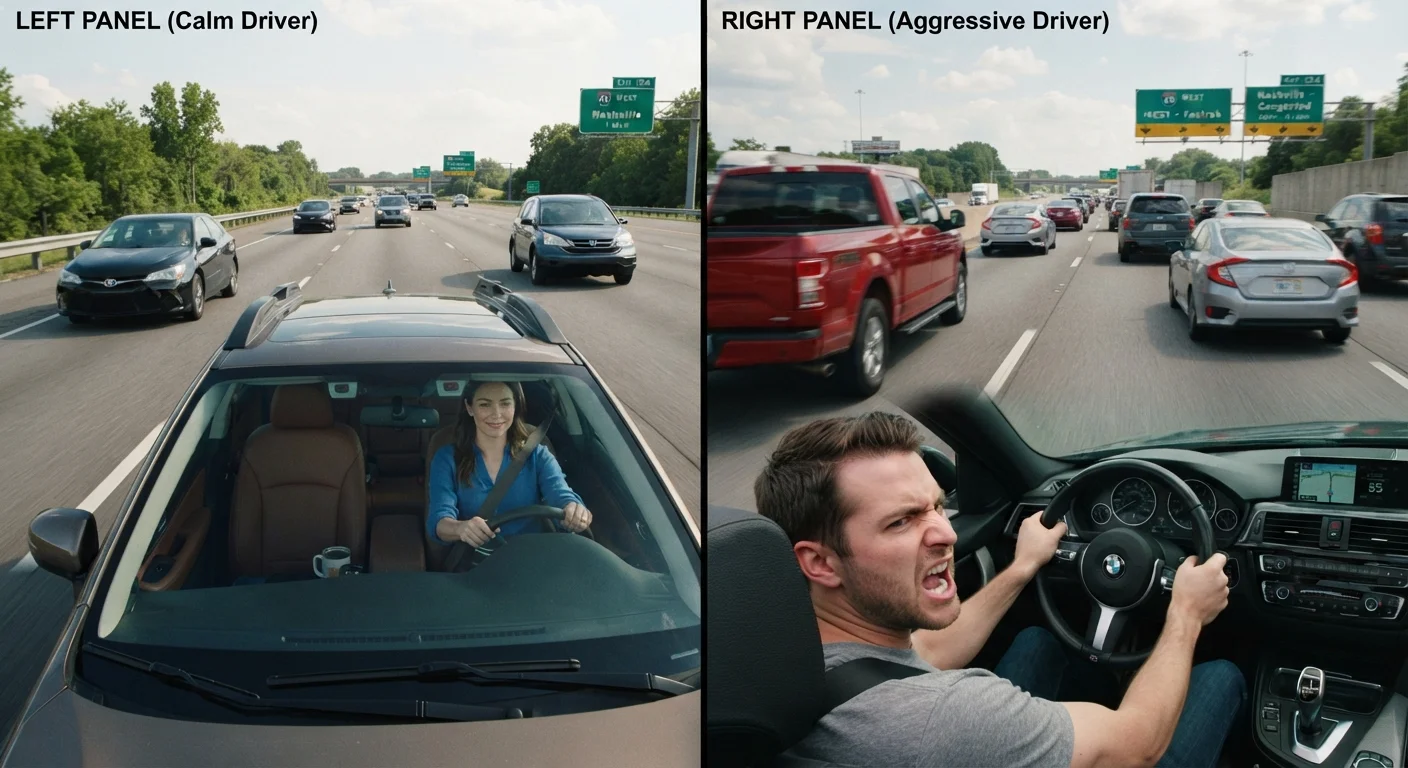
Defensive driving is a proactive approach: maintaining adequate following distance, scanning ahead for hazards, adjusting speed to conditions, and anticipating the behavior of other drivers. The concept is formalized in training programs developed by organizations such as the National Safety Council (NSC) and is taught in court-approved driver improvement courses across the US.
Aggressive driving is defined by the National Highway Traffic Safety Administration (NHTSA) as operating a vehicle in a way that endangers or is likely to endanger people or property. Specific behaviors include speeding, tailgating, unsafe lane changes, running red lights, and failure to yield. It sits below the legal threshold of road rage - which involves criminal intent - but shares its roots in impatience and frustration.
The distinction matters because aggressive driving isn't simply driving quickly. It's a cluster of simultaneous risk-taking behaviors that compound one another. See how smaller habits quietly degrade driving quality for related patterns.
What the Safety Data Shows
The crash risk differential between the two styles is not subtle. The NHTSA has attributed aggressive driving as a contributing factor in approximately one-third of all US traffic fatalities in its road safety analyses. Speeding alone - one component of aggressive driving - was a factor in 29% of all traffic fatalities in 2022, according to NHTSA data, resulting in over 12,000 deaths that year.
29%
US traffic fatalities involving speeding (2022)
According to NHTSA crash data, speeding contributed to over 12,000 deaths on US roads in 2022.
~33%
Fatalities linked to aggressive driving behaviors
The NHTSA has identified aggressive driving as a contributing factor in roughly one-third of all US traffic fatalities across its road safety analyses.
15-30%
Fuel economy reduction from aggressive driving
The US Department of Energy estimates this range for highway driving compared with smooth, anticipatory driving patterns.
Defensive driving, by contrast, is associated with lower collision rates in insurance actuarial studies and fleet safety programs. Commercial fleet operators - whose data is unusually complete because every incident is logged - consistently find that drivers trained in defensive techniques generate fewer at-fault incidents over multi-year periods.
The myths about speeding are worth confronting here: many drivers assume that small speed increases are broadly tolerated and carry minimal added risk. Traffic safety data does not support this. The relationship between speed and crash severity follows a nonlinear curve - small increases above safe thresholds produce disproportionately larger injury outcomes in a collision.
The Time-Savings Myth
Perhaps the most persistent justification for aggressive driving is that it's faster. The evidence consistently disappoints this belief.
Traffic flow research - including studies from the Texas A&M Transportation Institute - demonstrates that on congested urban commutes, aggressive lane changes and tailgating behavior provide minimal average speed gains. On a 20-mile urban commute, the realistic time differential between aggressive and defensive pacing is typically measured in seconds to low single-digit minutes, not the dramatic savings drivers perceive.
This happens because traffic is not a linear system. Cutting into a gap forces the vehicle behind to brake, creating a ripple effect (known as a shockwave) that slows overall traffic flow. The aggressive driver gains marginally but contributes to congestion behind them.
| Criterion | Defensive Driving | Aggressive Driving |
|---|---|---|
| Crash risk contribution | Significantly lower | Major factor in ~33% of fatalities |
| Realistic commute time saved | Minimal loss, consistent pace | Seconds to 1-2 min on most routes |
| Fuel economy impact | Optimized; up to 30% better | 15-30% worse on highways |
| Brake and drivetrain wear | Lower per-mile cost | Accelerated component wear |
| Driver stress levels | Lower; controlled engagement | Higher; reactive and frustration-driven |
| Traffic flow effect | Neutral to positive | Creates shockwave slowdowns |
On highway driving, the calculus shifts slightly - but city and highway driving demand different risk frameworks, and even on interstates, the time-distance math rarely justifies the added crash exposure.
Fuel Economy and Vehicle Wear
Driving style has a direct, measurable impact on fuel consumption. The US Department of Energy estimates that aggressive driving - characterized by rapid acceleration and hard braking - can lower fuel economy by 15-30% on highways and by a larger margin in stop-and-go city driving compared to smoother driving patterns.
Brake wear is also accelerated by aggressive habits. Hard braking generates more heat and friction, shortening pad and rotor life. Rapid acceleration stresses drivetrain components over time. These are not hypothetical long-term risks - fleet maintenance records routinely show higher per-mile maintenance costs for aggressive driver profiles.
For everyday commuters, behavioral changes behind the wheel have a more meaningful impact on fuel economy than many hardware modifications. Smooth, anticipatory driving is essentially a free efficiency upgrade.
Stress, Cognition, and Long-Term Driver Health
Aggressive driving is both caused by and a cause of elevated stress. Studies in traffic psychology, including research published in journals such as Accident Analysis & Prevention, find that aggressive drivers report higher baseline frustration, interpret neutral traffic events as personal provocations, and experience elevated cortisol during commutes.
Defensive driving, by contrast, is fundamentally a cognitive strategy. It requires active attention - scanning mirrors, reading brake lights ahead, tracking merge patterns - rather than reactive impulse. This engaged-but-calm state is associated with lower reported stress and, in long-term occupational driving research, with fewer indicators of commute-related burnout.
Nighttime driving amplifies these dynamics: reduced visibility narrows the window for anticipatory response, making the measured pace of defensive driving more valuable and aggressive habits more dangerous after dark.
Defensive Driving Is a Learnable Skill
Defensive driving is not a personality trait - it's a set of trainable behaviors. The National Safety Council, AAA, and many state DMVs offer formal defensive driving courses, some of which may qualify for insurance discounts depending on your insurer and state. These programs focus on hazard perception, space management, and emotional regulation behind the wheel. Completing one periodically can recalibrate habits that drift over time.